AR vs VR: Which Technology Is Right for Your Brand
Brands across the UAE and GCC are investing in immersive technology but the question that keeps coming up in every brief is the same: AR or VR?
Both are powerful. Both create memorable experiences. But they serve fundamentally different purposes, and choosing the wrong one can mean building a technically impressive activation that simply doesn't land with your audience.
This guide breaks down AR vs VR how each works, where each wins, and how to decide which is right for your next campaign.
What Is Augmented Reality (AR)?
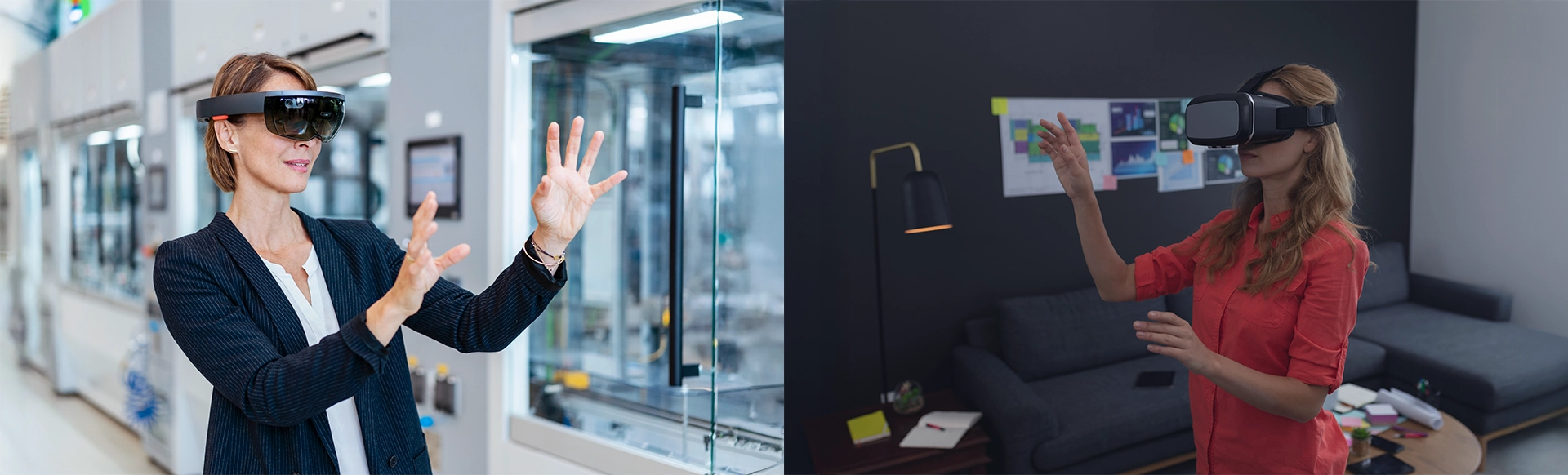
Augmented reality overlays digital content onto the real world. Users stay fully aware of their physical surroundings; the technology simply adds a layer visual, audio, or interactive on top of what they already see.
AR experiences are typically delivered through smartphones, tablets, or AR glasses. Think of a retail app that lets a customer visualise a sofa in their living room before purchasing, or a brand activation at an event where attendees scan a logo and watch it animate into a 3D experience. AR is additive. It enhances reality rather than replacing it.

Where AR Wins
-
Retail and e-commerce: Virtual try-ons, in-store product visualisation
-
Live events and activations: Logo triggers, photo moments, interactive brand mascots
-
Outdoor advertising: Scan-to-activate OOH campaigns
-
Product launches: Letting consumers interact with a product before it physically exists
-
Mass-reach campaigns: AR filters on Instagram and Snapchat reach millions without requiring specialist hardware
According to Deloitte, AR experiences increase purchase intent by up to 40% compared to static product images — making it one of the most commercially proven immersive formats available today. AR is the right choice when you need accessibility, scale, and a low barrier to entry.
What Is Virtual Reality (VR)?
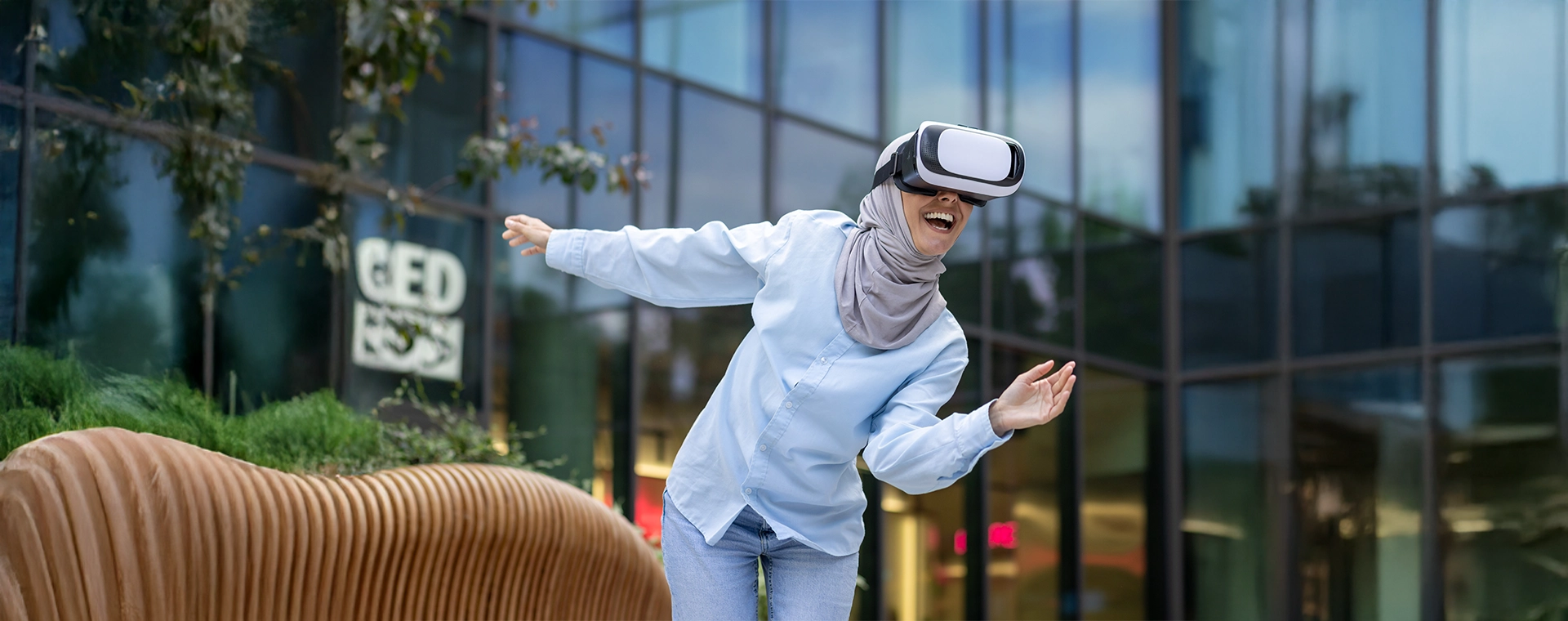
Virtual reality replaces reality entirely. Users wear a headset — such as a Meta Quest or HTC Vive — and are transported into a fully rendered digital environment. There is no physical world visible; the experience is 100% immersive.
VR demands more from participants: they need a headset, a physical space, and often some level of onboarding. But what it gives in return is unmatched depth of immersion. VR doesn't just show people something — it puts them inside it. VR is transformative. It doesn't add to reality; it creates a new one.
Where VR Wins
-
Brand storytelling: Place audiences inside your brand's world, values, or origin story
-
Training and simulation: High-stakes scenarios safety drills, surgical training, pilot simulations
-
Real estate and architecture: Walk through buildings that haven't been built yet
-
Automotive: Configure and test-drive vehicles in a fully virtual showroom
-
High-value B2B demonstrations: Give decision-makers an experience they cannot get anywhere else
PwC research found that VR learners are up to 4× faster to train than classroom learners and 275% more confident in applying skills after training. In brand contexts, this depth of engagement translates directly into emotional memory.
"Virtual reality isn't just a new medium — it's a new reality. The brands that understand this will shape how entire generations experience their products." — Jeremy Bailenson, Founding Director, Stanford Virtual Human Interaction Lab
VR is the right choice when you need deep emotional impact, exclusivity, and storytelling that cannot be told any other way.
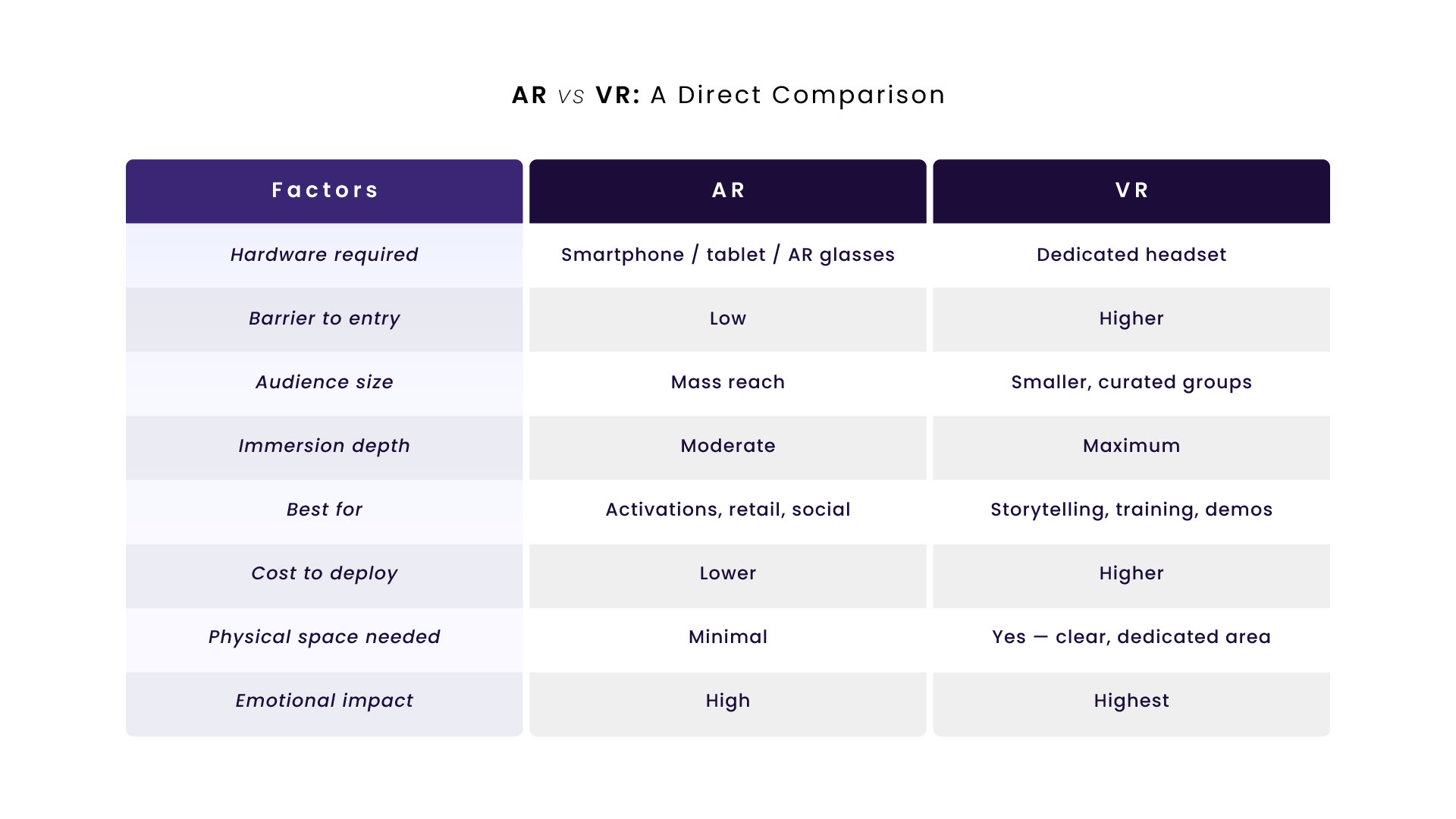
AR vs VR: A Direct Comparison
The Decision Matrix: How to Choose
Use this framework to guide your technology decision:
Choose AR if:
-
Your campaign needs to reach thousands of people simultaneously
-
You want audiences to share the experience on social media
-
You are activating at a public event, retail space, or outdoor location
-
Your budget is mid-range and scalability matters
-
You want an experience accessible without specialist equipment
Choose VR if:
-
You are targeting a smaller, high-value audience (C-suite, buyers, media)
-
Your story requires emotional depth that passive content cannot deliver
-
You are demonstrating something that doesn't yet physically exist
-
You are running a training or simulation programme
-
You want your brand to be associated with cutting-edge, premium experiences
The honest answer: many of the most effective campaigns use both. AR handles the broad activation — driving reach, social sharing, and mass engagement. VR creates the inner circle experience — reserved for VIPs, media, and decision-makers who receive something no one else gets.
Choosing for Your Next Campaign
The brands getting the most from immersive technology aren't asking "AR or VR?" as a binary question. They're asking: what do I want my audience to feel, and what's the most effective technology to make them feel it?
If you want your audience to discover, share, and engage AR. If you want your audience to feel, believe, and remember VR. If you want both build a campaign architecture that uses each where it is strongest.
Ortmor designs and delivers both AR and VR experiences for brands across the UAE and GCC. Whether you're planning a product launch, an event activation, or a long-term immersive marketing strategy, the right technology is the one built around your audience not around a trend.
Frequently Asked Questions
Q: Is AR or VR more effective for marketing?
A: It depends on your goal. AR is more effective for mass-reach campaigns, social activations, and retail experiences due to its low barrier to entry. VR is more effective for deep storytelling, high-value B2B demonstrations, and training scenarios where emotional impact and immersion are paramount.
Q: Which is cheaper to deploy — AR or VR?
A: AR activations are generally less expensive to deploy at scale because they require no specialist hardware on the audience's side. VR requires headsets and physical setup, making it better suited to smaller, curated experiences where the per-person investment is justified by the depth of engagement.
Q: Can a brand use both AR and VR in the same campaign?
A: Yes — and this is increasingly common. A hybrid approach uses AR for broad public engagement and VR for an exclusive inner-circle experience, maximising both reach and depth within a single campaign. Many of the most impactful activations at major UAE events have adopted this dual-technology model.
Q: What industries use VR the most?
A: Automotive, real estate, healthcare, defence, and luxury retail are the leading VR adopters globally. In the UAE, real estate, tourism, and large-scale events have seen the strongest VR investment, driven by government-backed digital transformation programmes.
Q: Do audiences in the UAE respond well to AR and VR experiences?
A: Yes. The UAE has one of the highest smartphone penetration rates in the world and a culturally strong appetite for innovation and premium experiences. AR and VR activations consistently outperform traditional formats in audience dwell time, social sharing, and post-event recall across GCC markets.
Sources & References
-
Deloitte — Extended Reality (XR) in Retail: The Future of Shopping Experiences
-
PwC — The Effectiveness of Virtual Reality Soft Skills Training in the Enterprise (2020)
-
Statista — Augmented Reality and Virtual Reality Market Revenue Worldwide
-
Grand View Research — Augmented Reality & Virtual Reality Market Size & Share Report
-
Forbes — How AR And VR Are Transforming The Marketing Industry
-
Stanford University — Virtual Human Interaction Lab, Jeremy Bailenson
-
Ortmor Agency — AR and VR Capabilities