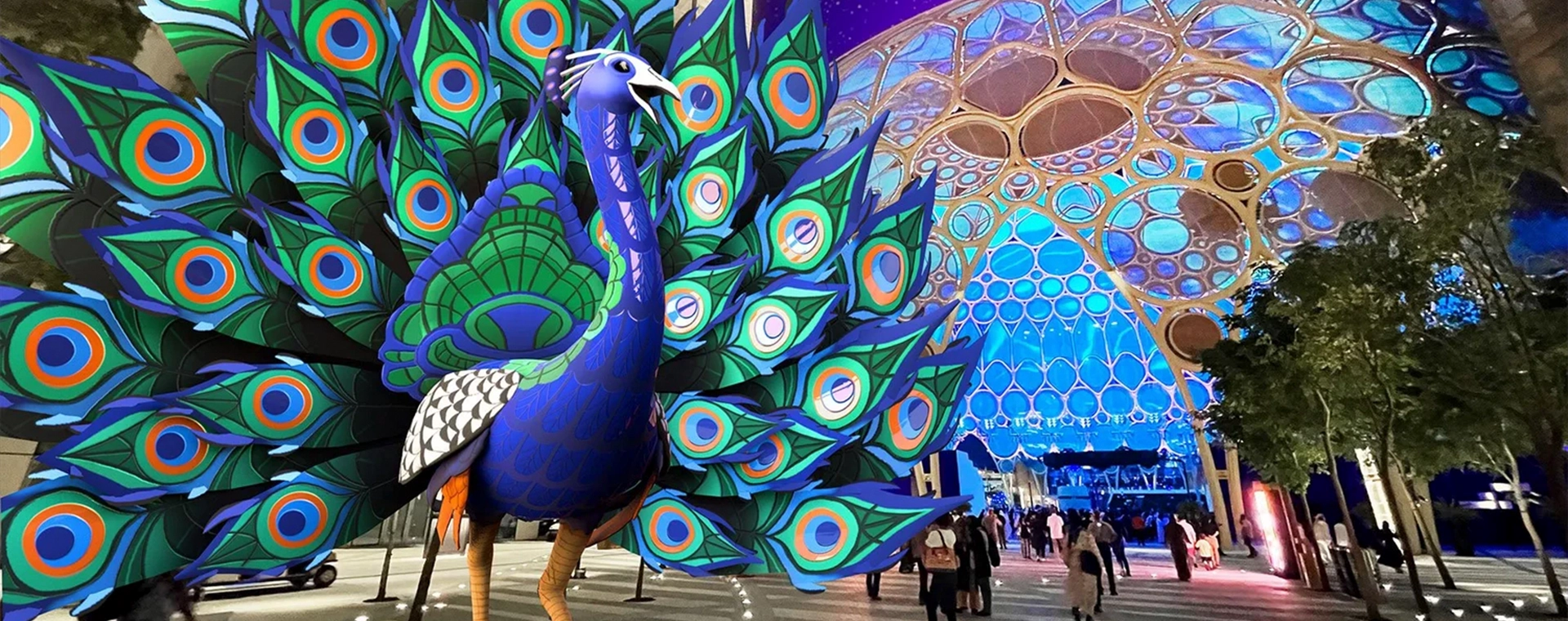
How AR Is Transforming Tourism Experiences in the UAE
Dubai welcomed 18.72 million international visitors in 2024 — a 9.15% increase year-on-year, according to the Dubai Department of Economy and Tourism. That figure tells one story. But the more telling trend is what those visitors expect when they arrive: not passive sightseeing, but interactive, layered, and personalised encounters with the places they've travelled to see.
Augmented reality tourism is answering that expectation. By overlaying digital information, animation, and interactive content onto the physical world through smartphones and AR devices, the technology is giving destinations a powerful new tool — one that makes heritage richer, navigation smarter, and brand activations impossible to ignore.
The UAE, already one of the world's most ambitious adopters of immersive technology, is at the centre of this shift. From the living legacy of Expo 2020 to the storied lanes of Al Fahidi, augmented reality is rewriting the rules of how visitors engage with this country. This article explains how it works, where it's already making an impact, and what it means for tourism brands and destination marketers operating in the region.
Why Augmented Reality Tourism Is Having Its Moment Now
The global market for augmented reality in travel and tourism was valued at $21.44 billion in 2024 and is projected to reach $109.13 billion by 2029 — a compound annual growth rate of 38.6%, according to The Business Research Company. That scale of growth does not happen by accident. It is driven by three forces converging simultaneously.
First, smartphone penetration in the UAE sits well above global averages. The infrastructure for AR — a capable camera, a GPS chip, and a data connection — is already in the hands of virtually every visitor who lands at Dubai International Airport.
Second, tourist expectations have fundamentally changed. Research by Smartvel found that 73% of tourists now actively seek destinations that offer technology-immersive experiences. Visitors no longer evaluate a destination solely by what there is to see — they evaluate it by how it feels to engage with it. A static plaque outside a fort cannot compete with a smartphone app that reconstructs the fort as it stood 300 years ago, in real time, through the visitor's camera lens.
Third, the UAE government has built the conditions for AR adoption at scale. Vision 2031 and the UAE's broader digital transformation agenda have seeded investment in smart infrastructure across tourism, heritage, and hospitality sectors — making the country fertile ground for the kind of AR deployments that, elsewhere, remain experimental.
What Augmented Reality Tourism Actually Looks Like: From Heritage Sites to Hotel Lobbies
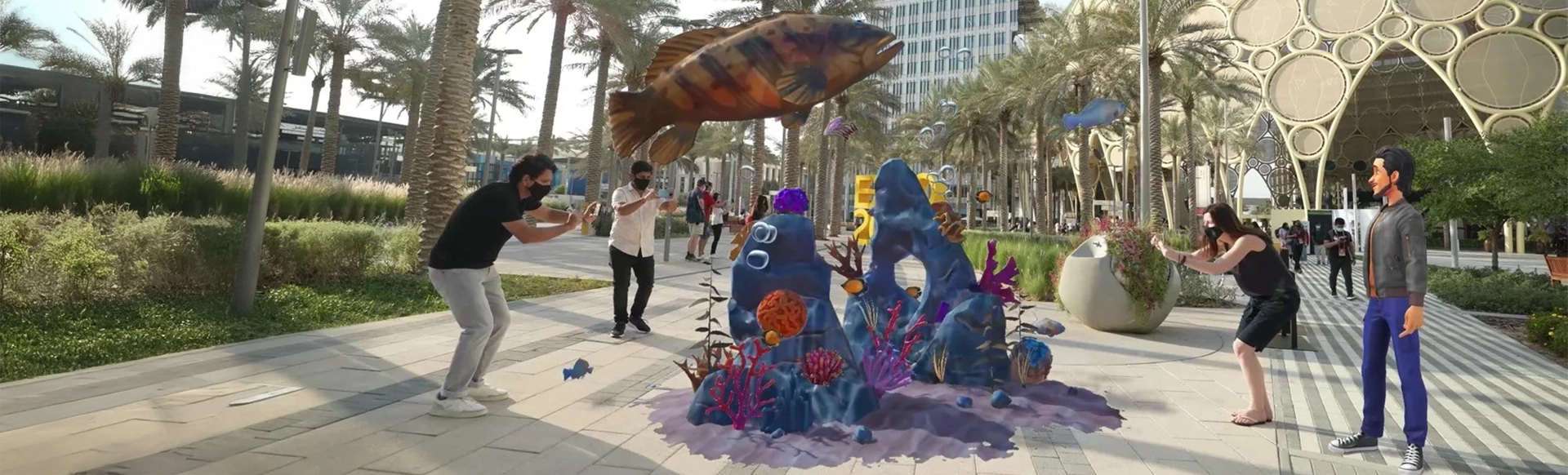
The clearest proof of AR's tourism potential in the UAE is what happened at Expo 2020 Dubai. The event deployed one of the world's largest persistent Cloud Anchors — the spatial data system that pins digital content to exact real-world locations — allowing millions of on-site visitors to experience AR spectacles accurately anchored to physical structures across the 4.38 km² site. The Expo 2020 mobile app layered AR quests, interactive visualisations, and navigational overlays onto the physical experience. Virtual visitation reached 145 million. The infrastructure and the ambition it represented have not disappeared — they live on through Expo City Dubai, which continues to evolve as a testbed for immersive visitor experience.
Heritage tourism is another domain where AR is delivering real transformation. Apps and on-site AR systems at locations like the Dubai Museum and Al Fahidi Historic District allow visitors to use their smartphones to reconstruct how buildings once looked, access contextual storytelling about Emirati culture, and interact with digital guides in multiple languages — eliminating the friction of language barriers that historically muted the experience for international visitors.
The hospitality sector is moving equally fast. Properties like W Dubai – The Palm have integrated AR into the guest journey itself, allowing guests to scan sculptures and artwork around the property and watch them animate. During the Dubai Shopping Festival, AR transforms retail environments into interactive treasure hunts, with virtual rewards and discounts visible only through a smartphone camera. The Visit Dubai digital ecosystem — expanded under DCTCM's leadership — increasingly positions AR not as a novelty but as a standard layer of the destination experience.
"Tourism is central to Dubai's economic growth and diversification." — Issam Kazim, CEO, Dubai Corporation for Tourism and Commerce Marketing (DCTCM)
That positioning reflects a mature understanding of what augmented reality tourism actually delivers: not a gimmick bolted onto a destination, but a richer relationship between visitor and place.
The Business Case: Why UAE Tourism Brands Are Investing in AR
For destination marketers and experience designers, the case for augmented reality tourism is increasingly hard to ignore on commercial grounds alone.
Research published by Arrivia found that travellers who use AR tools during trip planning and on-site exploration spend up to $225 more per trip than those who don't. When AR enriches the experience, visitors stay longer at attractions, engage more deeply with retail and F&B offerings around them, and return to a destination more readily. That is not soft data — it is a direct argument for AR as a revenue-driving investment, not a cost centre.
The UAE's own AR and VR market is projected to reach $204.2 million in revenue by 2029, growing at a CAGR of 9.67% according to Statista. Much of that growth is tourism-adjacent: hospitality integrations, attraction enhancements, cultural site activations, and destination marketing campaigns built around immersive content.
For brand managers and CMOs activating around tourist footfall — whether launching a product at a Dubai attraction, building an experience at a heritage site, or running a campaign tied to the Visit Dubai calendar — AR unlocks a category of engagement that no other medium matches. It is physical and digital simultaneously. It is social and shareable by design. And in a market where 18.72 million visitors are actively seeking memorable experiences, it creates exactly the kind of moments that generate organic reach long after the campaign ends.
What Ortmor Delivers for Tourism and Destination Brands in the UAE
Ortmor Agency has been designing and delivering augmented reality experiences across the UAE for tourism and destination clients, working at the intersection of creative storytelling and technical execution. The approach is built on a consistent conviction: technology is only as good as the experience it creates. An AR activation that confuses visitors, demands excessive setup, or delivers thin content is worse than no activation at all.
What Ortmor brings to tourism and destination briefs is the capacity to think through the full visitor journey — from the moment someone points their phone at a landmark or walks into an exhibition space, to the social content they share when they leave. Past projects documented in Ortmor's case studies span immersive heritage installations, brand-led AR activations at events and public spaces, and experiential marketing campaigns designed for high-footfall environments across the UAE and GCC.
The agency's experiential marketing capabilities extend AR beyond standalone tech demos into integrated campaigns: deployments at cultural festivals, tourism board activations, government-led heritage projects, and national day experiences where the scale and cultural sensitivity of the execution demand a partner with both creative rigour and regional expertise.
If you're planning a tourism or destination experience in the UAE and want to understand what AR can realistically deliver for your brief, the Ortmor team is the right starting point.
Conclusion
Augmented reality tourism is not a future-state technology in the UAE — it is already reshaping how visitors engage with Dubai's heritage, its hotels, its retail environments, and its world-class attractions. The commercial case is established. The market infrastructure is in place. And the visitor appetite is demonstrably there.
What separates destinations that capture that value from those that miss it is execution: the quality of the experience, the clarity of the creative thinking behind it, and the technical capability to deliver at scale without friction. For brands and destination marketers operating in this space, the window to differentiate through AR is open — but it will not stay wide indefinitely.
The UAE's most ambitious experiences are already being built. The question is whether your destination or brand will be part of them.
Frequently Asked Questions
Q: What is augmented reality tourism and how does it work?
A: Augmented reality tourism uses smartphone cameras, GPS, and digital overlay technology to layer interactive content — 3D models, historical reconstructions, translations, information cards, and animations — onto the real-world environment a visitor is standing in. Unlike virtual reality, which replaces the physical world, AR enhances it. A visitor can point their phone at an ancient fort and see it as it looked centuries ago, or scan a museum exhibit and unlock a multilingual audio-visual guide, all without removing themselves from the actual location.
Q: How is Dubai using augmented reality to enhance the visitor experience?
A: Dubai has integrated AR across multiple layers of the visitor journey. The Expo 2020 mobile app deployed persistent Cloud Anchors across the entire 4.38 km² Expo site for real-time AR quests and spatial experiences. The Dubai 360 app overlays historical facts and AR pop-ups onto landmarks like the Burj Khalifa. Heritage sites including the Dubai Museum and Al Fahidi Historic District use AR guides to reconstruct historic environments. The Dubai Shopping Festival has used AR to turn malls into interactive treasure hunts. These deployments position AR as a standard feature of the destination experience, not an add-on.
Q: What is the difference between AR and VR in tourism?
A: Augmented reality (AR) overlays digital content onto the real world — the visitor stays physically present at the destination while experiencing additional digital layers. Virtual reality (VR) replaces the physical environment entirely with a simulated one, typically requiring a headset. In tourism, AR is generally better suited to on-site activation at real locations: heritage sites, attractions, hotels, and events. VR is more commonly used for pre-trip inspiration, remote destination previews, and training environments. Both have a role in the UAE's tourism technology ecosystem, and many major destinations deploy both depending on the use case.
Q: Can AR help heritage and cultural sites attract more and younger visitors?
A: Yes — and this is one of AR's most documented use cases in tourism globally. Heritage sites often struggle to contextualise their significance for international visitors unfamiliar with local history, and to engage younger audiences accustomed to interactive digital experiences. AR bridges both gaps: it provides rich, visually engaging context in any language, makes exploration feel gamified and participatory, and generates shareable social content that extends the site's marketing reach organically. Research consistently shows that AR-enhanced attractions hold visitor attention longer and improve recall of cultural content compared to traditional interpretation methods.
Q: How can a tourism brand or destination in the UAE start an AR project?
A: The most effective starting point is a clear brief: what visitor behaviour are you trying to change or enhance, at which physical location, and for which audience? From there, an experienced AR agency can scope the appropriate technical approach — whether that's a web-based AR experience accessible without an app download, a native app integration, or a bespoke spatial computing deployment. For UAE and GCC destination brands, working with a regionally experienced agency ensures the execution aligns with local cultural sensitivities, regulatory requirements, and the technical infrastructure of specific venues. Ortmor Agency works with tourism and destination clients across exactly this kind of brief — explore their AR capabilities here.
Sources & References
- Dubai Department of Economy and Tourism — Annual Visitor Report 2024 — Dubai DET (2025)
- The Business Research Company — Augmented Reality in Travel and Tourism Global Market Report (2024)
- Smartvel — How Augmented Reality is Revolutionizing Tourism (2024)
- Arrivia — Integrating Augmented Reality in Travel & Tourism (2024)
- Statista / Appinventiv — AR/VR in Dubai: Exploring the Dynamic Innovations and Impact (2024)
- Magnopus — Dubai Expo 2020: Cross-Reality Experience (2022)
- Economy Middle East — H.E. Issam Kazim on Dubai's record-breaking 18.72 million overnight visitors (2025)
- Think with Google — How Dubai Expo 2020 captured 250 million virtual visitors' hearts (2022)