Building Projection Mapping in the UAE: How Architects and Brands Are Rewriting the Skyline
Imagine 50,000 people standing in silence, then gasping in unison as an entire building cracks open, dissolves into sand, erupts into colour. No headsets. No apps. No barriers. Just light, architecture, and a crowd that cannot look away.
That is what building projection mapping does. Nothing else really compares.
Digital advertising competes for a fraction of a second of someone's attention. Projection mapping takes over an entire skyline. It turns buildings into living canvases, public squares into shared experiences, and ordinary evenings into moments people talk about for months. And because a well-executed show is genuinely spectacular, it creates organic social media content that money cannot buy. Thousands of people filming and posting at the same time, without being asked.
The global projection mapping market was valued at USD 5.7 billion in 2024 and is forecast to reach USD 17.8 billion by 2030, growing at a CAGR of 21.7% (Mordor Intelligence, 2025). Much of that momentum runs through the UAE. A country built for this kind of spectacle, with landmark architecture, a packed cultural calendar, and audiences who set high expectations. This guide covers how the technology works, where it has been used across Dubai, Sharjah and Abu Dhabi, what it actually costs, and what to think about before commissioning a production.
Why Projection Mapping Cuts Through
In a market full of screens, social ads and digital noise, projection mapping does one thing very well: it gets everyone's attention at the same time. No app, no headset, no device needed. Everyone in the space sees it. Whether that is 500 guests at a brand event or 50,000 people in an open square, the experience lands simultaneously for all of them. Nobody is left out. Nobody needs to be onboarded.
That scale matters more than it might seem. A projection show cannot be scrolled past. It occupies the physical environment. Bystanders become an audience without choosing to, and unlike most branded experiences, what they witness is a genuinely shared moment. Something people want to talk about, post and revisit long after the evening ends.
The social media impact is real and measurable. When a building transforms in front of thousands of people, those thousands all reach for their phones. Posts go up across Instagram, TikTok, X and WhatsApp without a single paid boost. The show becomes its own media event, generating reach that most campaign budgets would struggle to replicate through paid channels alone.
There is also something harder to quantify but easy to observe. When an audience watches a building appear to flood, bloom with flowers, or shapeshift around a brand story, they are not just looking at advertising. They are experiencing something. Research backs this up: building-scale projection experiences boost on-site dwell time by up to 40%, a figure that matters enormously in any activation context where longer engagement means better conversion (NewMedia Immersive Events, 2025).
How Building Projection Mapping Works
Building projection mapping comes down to three things working together: the projectors, the content, and the software that holds it all in sync.
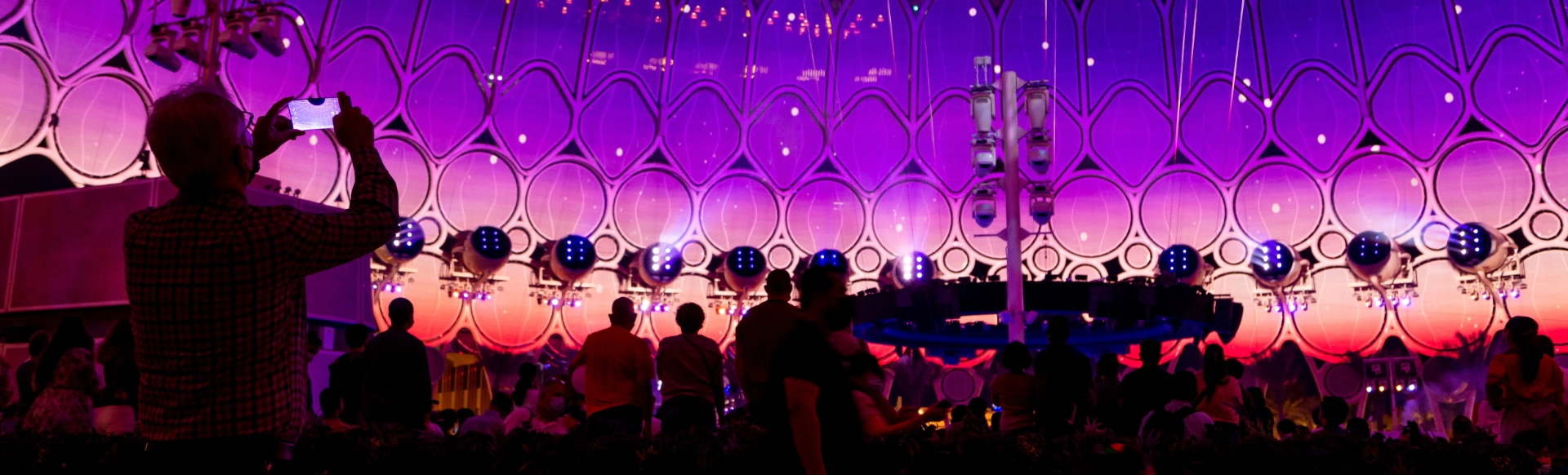
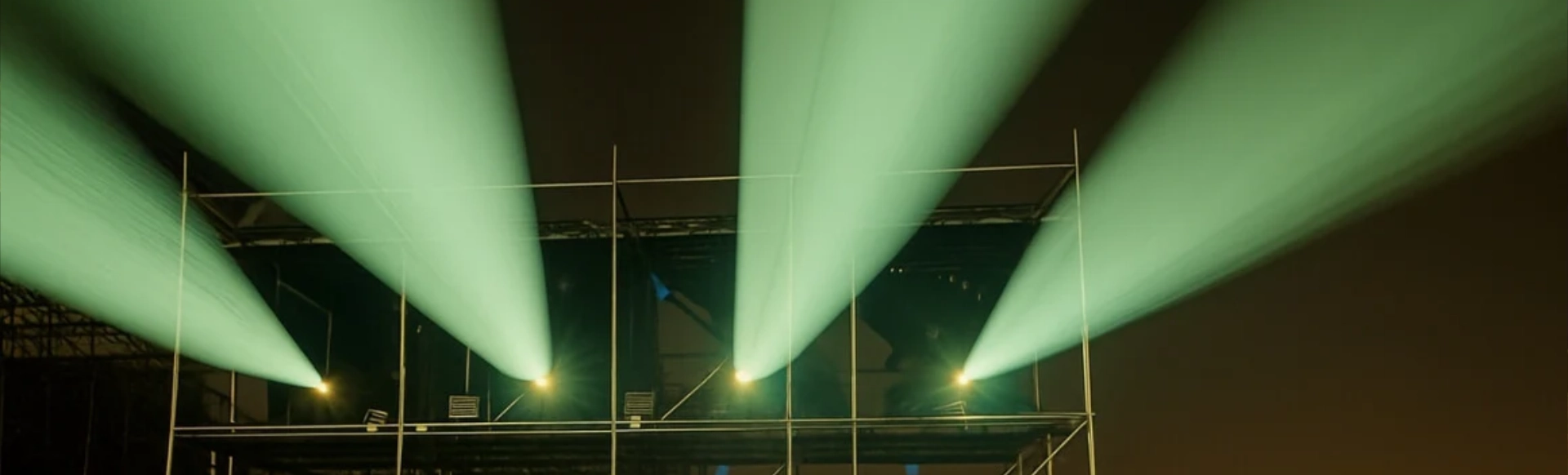
The projectors take the most planning. For outdoor, building-scale work you need high-lumen laser units capable of cutting through ambient light across distances of 50 to 200 metres or more. To give a sense of scale: Expo 2020 Dubai's Al Wasl Dome used 252 Christie D4K40-RGB laser projectors arranged in 42 pods around the dome's inner perimeter, covering a 130-metre-diameter surface at 65 metres high. That was the world's largest 360-degree projection surface at the time (Christie Digital / Disguise, 2022). A single hotel facade for a brand event might need four to eight projectors. A landmark National Day show can run into dozens.
The content is typically where the most money goes and where the most time is spent. Every piece is built against a precise 3D digital model of the building facade, with every window, ledge and curve mapped in. That is what allows the building to appear to crack apart, flood, or morph into something else entirely. It is not a video playing on a wall. It is content made specifically for that surface, and that distinction shows.
The software, platforms like Disguise and Resolume, handles the complex job of warping, blending and synchronising multiple projectors across one surface. AI tools are beginning to speed up some of the most labour-intensive parts of this process, which is compressing timelines, but the creative and technical work still takes serious expertise.
Outdoor vs. Indoor: Two Different Creative Contexts
Outdoor work transforms hotel facades, cultural buildings, mall exteriors and public plazas. These are the big, visible activations: National Day shows on government buildings, Ramadan illuminations on mosque facades, brand launches on landmark hospitality venues. The scale is enormous, but so is the logistics. Projectors need to sit somewhere with clear sightlines, often a building across the street, a rooftop, or a purpose-built platform, and getting there involves site planning, structural agreements, power infrastructure and permits.
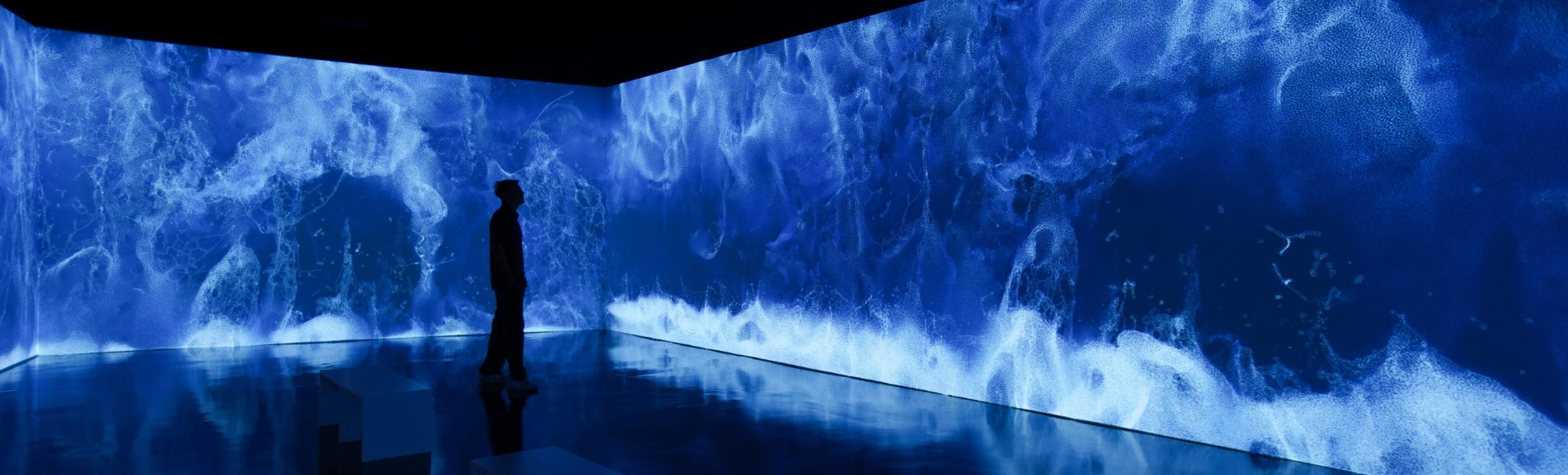
Indoor work gives you more control. In hotel ballrooms, exhibition halls, museum galleries, branded experience centres or event domes, you are working without ambient light competing against you. Distances are shorter, which means richer colour and sharper detail. Indoor projection mapping is also increasingly the choice for longer-term installations: brand showrooms, customer experience centres and cultural venues that want a dynamic space without the ongoing complexity of a full LED build.
UAE Landmark Case Studies
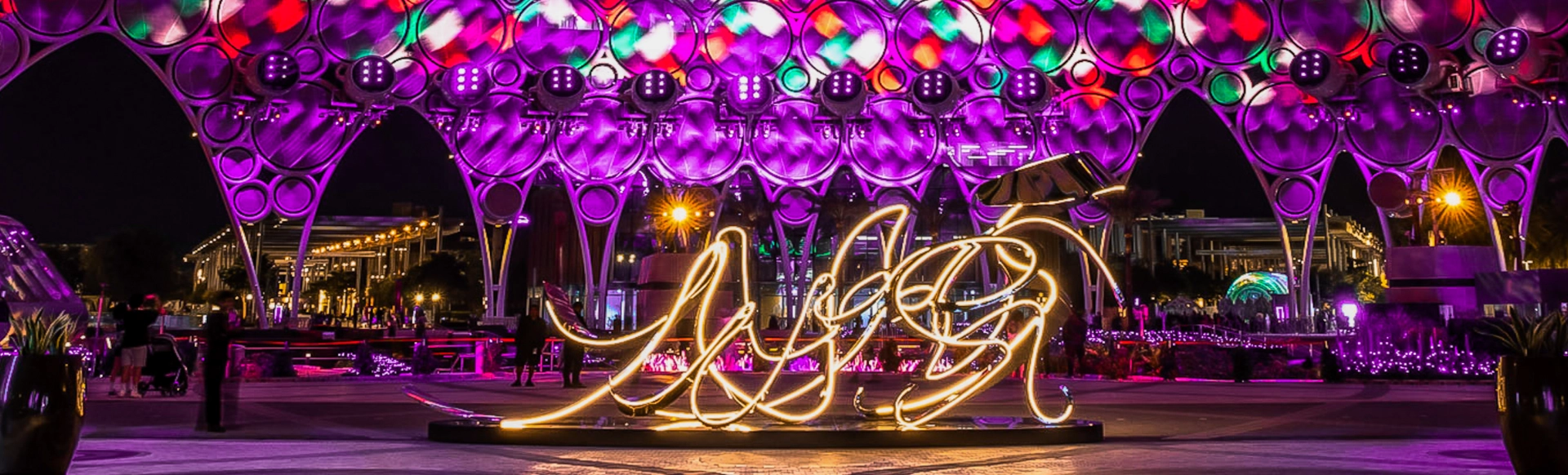
Al Wasl Dome, Expo 2020 Dubai. The 65-metre dome at what is now Expo City Dubai is still the benchmark for projection mapping at scale in this region. With 252 Christie laser projectors delivering immersive content to 24.1 million visitors across six months, it showed what a purpose-built indoor projection environment can achieve when the architecture and the technology are designed together from the start. The dome still hosts projection shows today as part of Expo City Dubai's events calendar.
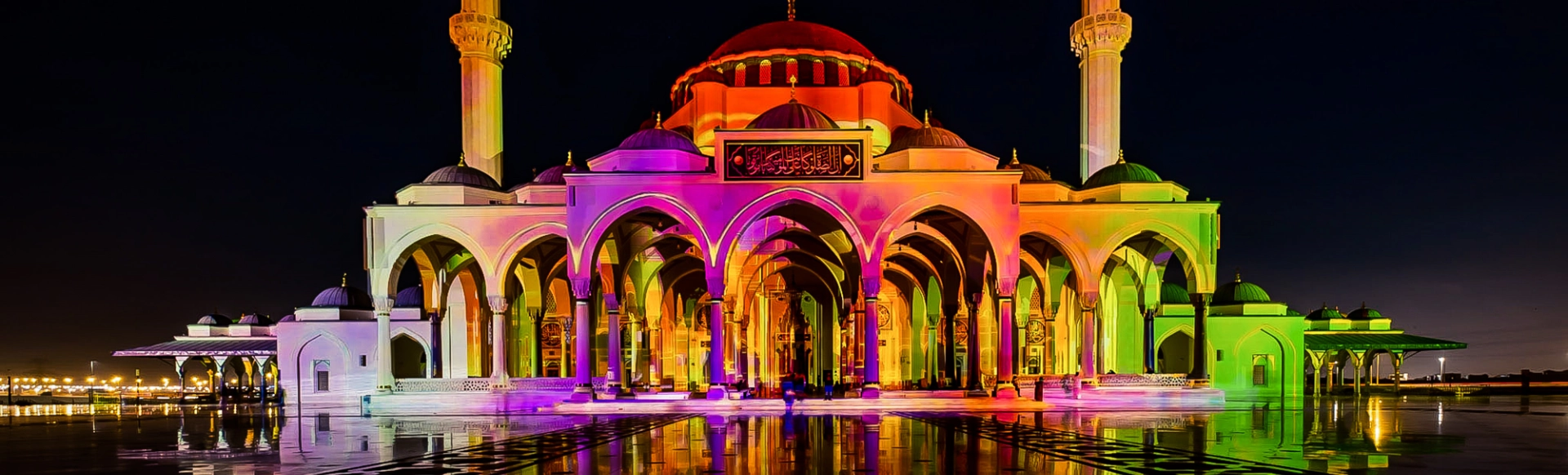
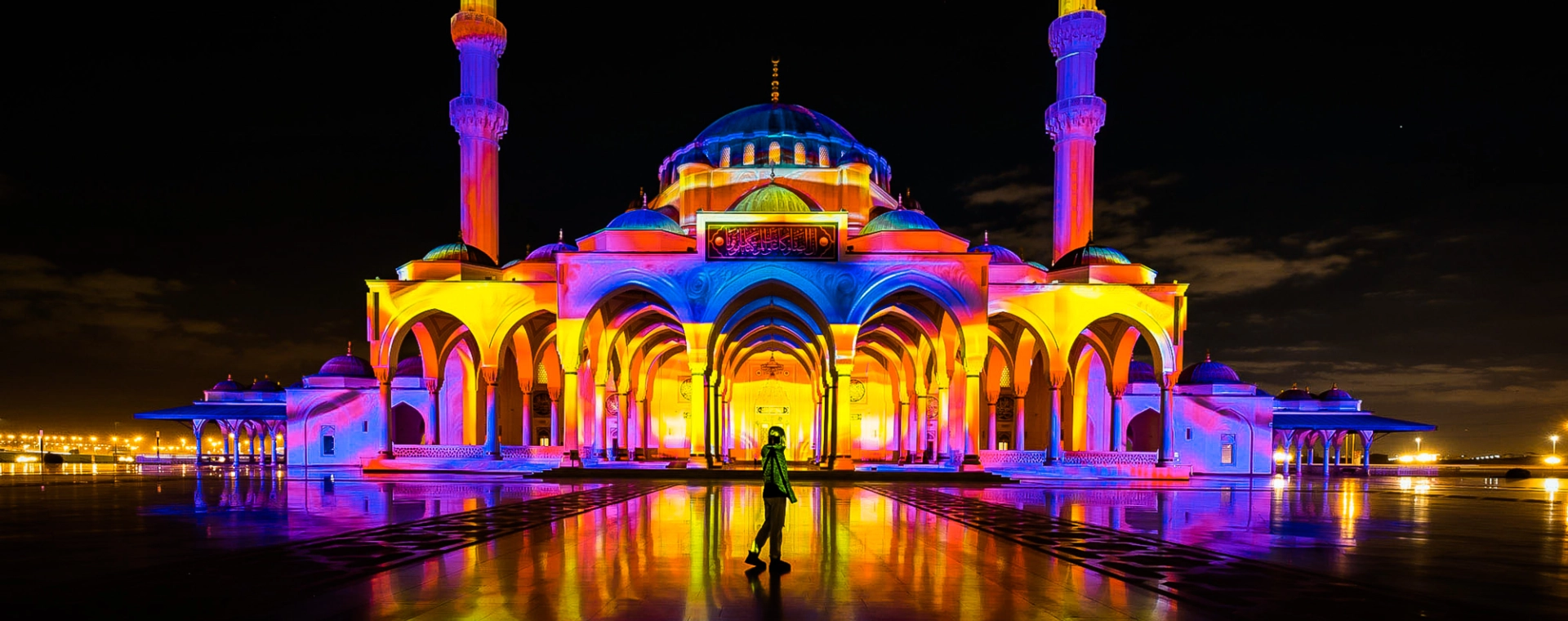
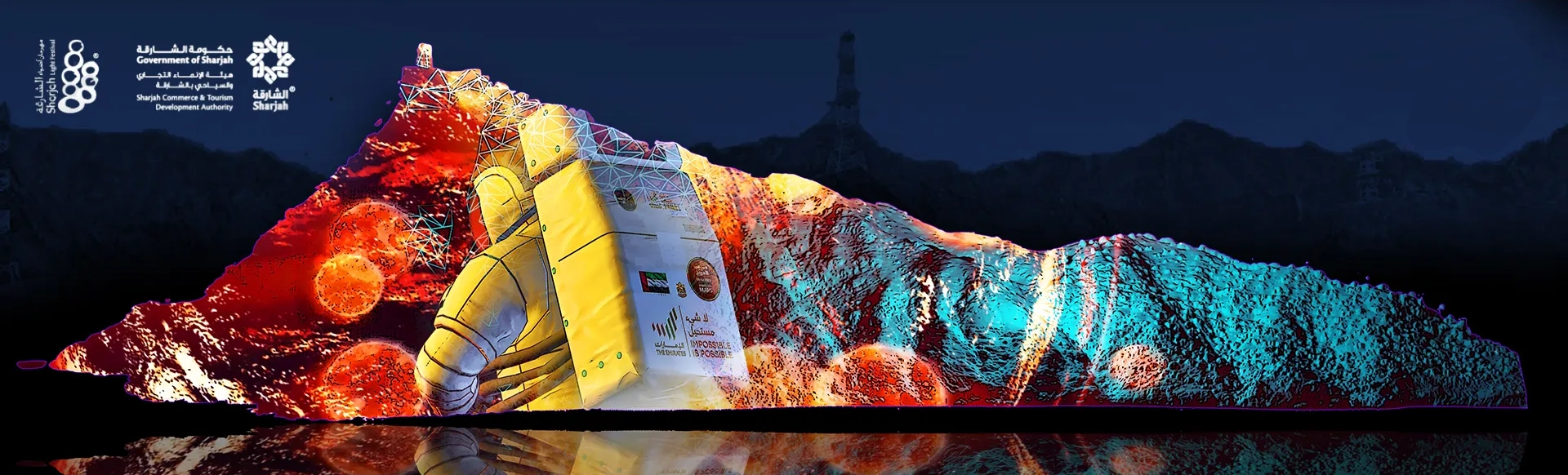
Sharjah Light Festival. Now in its 15th year, the Sharjah Light Festival is the UAE's most consistent large-scale showcase of the discipline, and one of the most ambitious annual projection mapping events anywhere in the world. Each edition, internationally known artists transform mosques, forts, souks and landmarks across the emirate. The 2024 edition was genuinely extraordinary. Production company Artabesk deployed 21 TITAN Laser 37000 WU projectors across the 400m2 surface of Sharjah Mosque, including minarets almost 40 metres tall. The same team then created a 300-metre by 50-metre projection on the face of the Al Rafisah Dam mountain, with 12 animated swans appearing to emerge from the rockface and dance on the water below. It was a reminder that projection mapping does not need a building at all.
Anwaar Dubai, Ramadan 2025. Brand Dubai's "Anwaar Dubai" initiative illuminated four major mosque facades during Ramadan 2025, including the Jumeirah Grand Mosque and Zabeel Grand Mosque, with projection mapping that animated architectural details using Islamic geometric art. One of the more culturally considered uses of the medium in the region, it showed that this technology can carry real meaning, not just spectacle.
UAE National Day. December 2nd has become a reliable annual showcase for architectural projection. The Dubai Municipality Building was transformed with a 3D laser and light show for the UAE's 51st National Day in 2022, one of many government-commissioned projections that now mark the date across both Emirates each year.
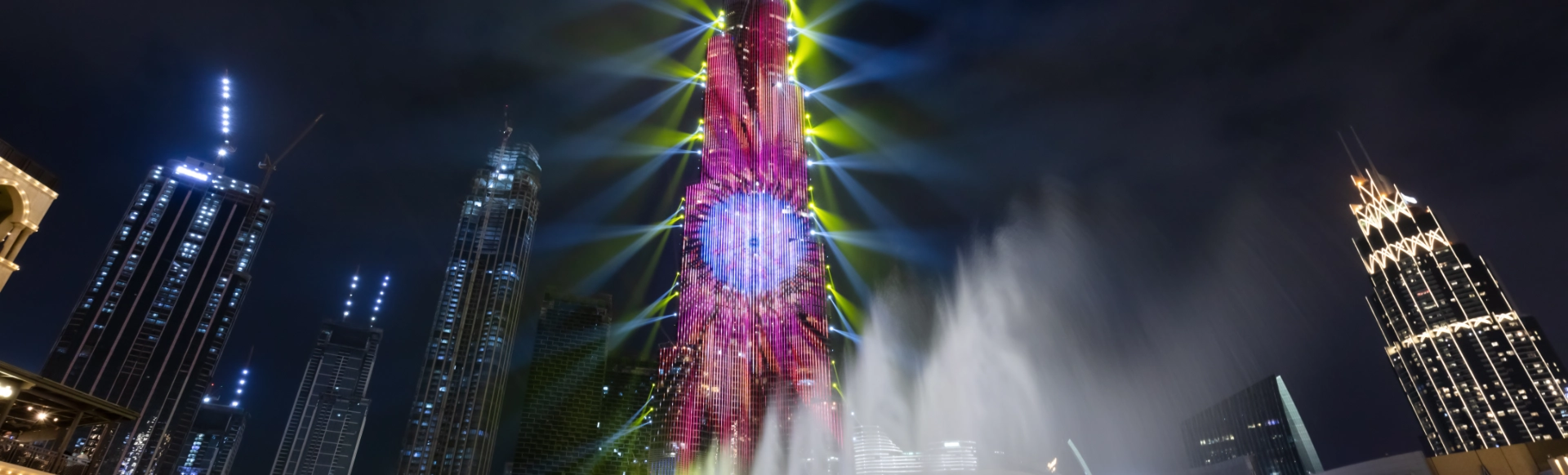
A note on the Burj Khalifa. The tower's famous shows, for New Year's Eve, Diwali, Chinese New Year, Indian Independence Day, Eid, Shah Rukh Khan's birthday, run through a permanently integrated LED system, not projection mapping. There is simply no practical way to position enough projectors across Downtown Dubai to cover a structure that tall. The technology is different, but the underlying idea is the same: use the building as a communication medium.
What the Burj Khalifa's content calendar actually tells you is something important about Dubai itself. The tower marks Eid with the same seriousness as it marks Chinese New Year. It lights up for Bollywood birthdays and Indian Independence Day. The building celebrates every culture that makes up this city, and that sends a clear message about what kind of place Dubai is. For anyone planning projection mapping campaigns here, that same thinking applies. The most effective building-scale communication speaks directly to whoever is actually standing in front of it.
The Real Challenges
Projection mapping is high-impact, but it takes real work to execute properly. Teams that underestimate the complexity tend to run into delays, budget surprises or results that fall short on the night.
Hardware logistics and setup. Large outdoor projectors are heavy, require stable mounting structures and serious power supply, usually generator support, and can take days to calibrate on-site. Finding the right location for them is often harder than expected. In dense urban areas like Downtown Dubai or DIFC, you need clear sightlines to the target building at the right throw distance. Not always easy. This is not a setup you do on the morning of the event.
Weather. The UAE climate is good for outdoor projection, but it has its risks. Sandstorms reduce visibility and coat lens surfaces mid-event. Summer heat puts strain on hardware. Humidity near the coast, in Abu Dhabi or parts of Dubai, can cause condensation in equipment. Any outdoor production needs a contingency plan and projectors housed in properly ventilated, weather-protected enclosures built into the spec from day one.
AV and content cost. The hardware alone, high-lumen laser projectors, media servers, cabling, rigging, power infrastructure, is a real budget item before a single frame of content is produced. Bespoke content adds considerably more on top: 3D site modelling, animation, compositing, show programming. These two costs belong in the same budget conversation from the start, not treated as separate lines that get discovered at different stages of the project.
Renting, leasing or buying. The right answer depends entirely on how long the installation runs.
For short, one-off events, a brand launch, a product reveal, a single National Day show, renting from a production partner is the right move. They bring the hardware, manage it, and take it away. You pay for the show, not the equipment.
For longer activations running between one and six months, a festival residency, a seasonal installation, an expo presence, leasing makes more sense. Daily rental rates over that kind of period add up fast. A lease gives you continuity without the capital cost of ownership.
For permanent installations, a brand experience centre, a flagship retail space, a cultural venue with an ongoing projection programme, buying the hardware is the right long-term investment. The cost per show drops substantially once the equipment is owned, and content can be refreshed without the logistics of remobilising rental kit each time.
What This Looks Like for Your Brand
Projection mapping works best when the message, the surface and the audience are genuinely aligned. For an automotive brand launching in Dubai, a landmark hotel facade becomes the showroom. For a government entity on National Day, a cultural building becomes the storytelling medium. For a fashion house during a major retail event, a mall exterior becomes the campaign.
At Ortmor, our projection mapping work in Dubai covers everything from site surveys and 3D architectural modelling through to content creation, projector positioning and live show production. We bring projection mapping into broader experiential marketing activations too, combining it with AR triggers, interactive elements and LED environments when the brief calls for it. Past Ortmor case studies show the range of projects delivered across the UAE and GCC.
Conclusion
Projection mapping is not going anywhere. In a country like the UAE, with the architecture, the events calendar and the appetite for spectacle that it has, this technology fits naturally and works hard.
The brands and institutions that get the most from it are the ones that plan properly and treat the whole thing as one joined-up production, not a creative idea bolted onto a technical afterthought. When everything lines up, the result is something no billboard, no social campaign, no pop-up experience can replicate.
If you are planning a National Day activation, a Ramadan programme, a product launch or a longer-term installation, start the conversation early. Contact Ortmor to talk through what is possible for your brief.
Frequently Asked Questions
Q: What is building projection mapping?
A: Building projection mapping, also known as architectural projection mapping or video mapping, is the process of projecting custom-animated video content onto a building's exterior to create visual illusions that interact with the physical structure. High-lumen laser projectors are positioned at precise angles and distances, while mapping software ensures the content wraps accurately around every surface contour, making the building appear to move, transform, flood with water, or dissolve entirely. No special devices or glasses are needed. The experience is accessible to every person in the audience simultaneously.
Q: How much does building projection mapping cost in the UAE?
A: Cost varies significantly based on the scale of the building, show duration, content complexity, and number of projectors required. Small-scale facade projections for brand events typically start from AED 50,000 to 150,000. Landmark-scale productions, such as National Day shows on major public buildings, can reach into the millions of dirhams once projector hire, bespoke content production, technical crew, site permits, and show management are factored in. A detailed site survey and brief review is the most accurate starting point for scoping.
Q: How long does it take to plan a building projection mapping show?
A: A mid-scale building projection typically requires six to twelve weeks from brief to live show. This covers site survey and technical assessment, 3D modelling of the building facade, bespoke content production, projector positioning, permit applications (required for public projections in Dubai), equipment setup, and technical rehearsals. National Day or Ramadan programmes of significant scale should ideally enter pre-production at least three to four months before the event date.
Q: What buildings have been projection-mapped in the UAE?
A: The UAE has an extensive catalogue of architectural projection mapping. Expo 2020 Dubai's Al Wasl Dome served as the world's largest 360-degree projection surface. The Sharjah Light Festival transforms mosques, forts, and souks across Sharjah annually, and in 2024 projected a 300m x 50m show onto the Al Rafisah Dam mountain face. Brand Dubai's Anwaar Dubai Ramadan initiative mapped four major mosque facades in 2025. The Dubai Municipality Building featured projection for National Day 2022. Across both Emirates, government buildings, hotels, and cultural landmarks are regularly used as projection canvases for major events.
Q: Can projection mapping be used for brand activations and product launches?
A: Yes, and it is increasingly the medium of choice for brands that need genuine scale and impact. Building projection mapping transforms landmark facades into campaign canvases, creating shareable moments that drive significant organic social media reach. Automotive, fashion, luxury, and FMCG brands have all used it at scale across Dubai and Abu Dhabi. When integrated with interactive elements and AR layers, it becomes a fully participatory brand experience that caters to hundreds or thousands of people at once without any barrier to entry.
Sources & References
-
Mordor Intelligence — Projection Mapping Market Report (2025)
-
Christie Digital / Disguise — Breathtaking Projections at Dubai Expo 2020 Powered by Disguise (2022)
-
ISP Audio Light Magazine / Digital Projection — Large-Scale Projection Mapping for the Sharjah Light Festival
-
Digital Projection — Moving Mountains at Sharjah Light Festival
-
UAE Media Office / Brand Dubai — Anwaar Dubai: Mosques Transformed with Light Projections (March 2025)
-
NewMedia Immersive Events — The State of Projection Mapping in North America: 2025 Data, Trends & What Brands Need to Know (2025)
-
The National — Burj Khalifa Lights Up for Shah Rukh Khan's Birthday
-
Top Interactive Agencies — "Immersive Work Has To Earn Its Place" — Dan Ferguson, Groove Jones (2024)