Hologram AI Assistant: Why Event Crowds Are Queuing to Talk to Thin Air
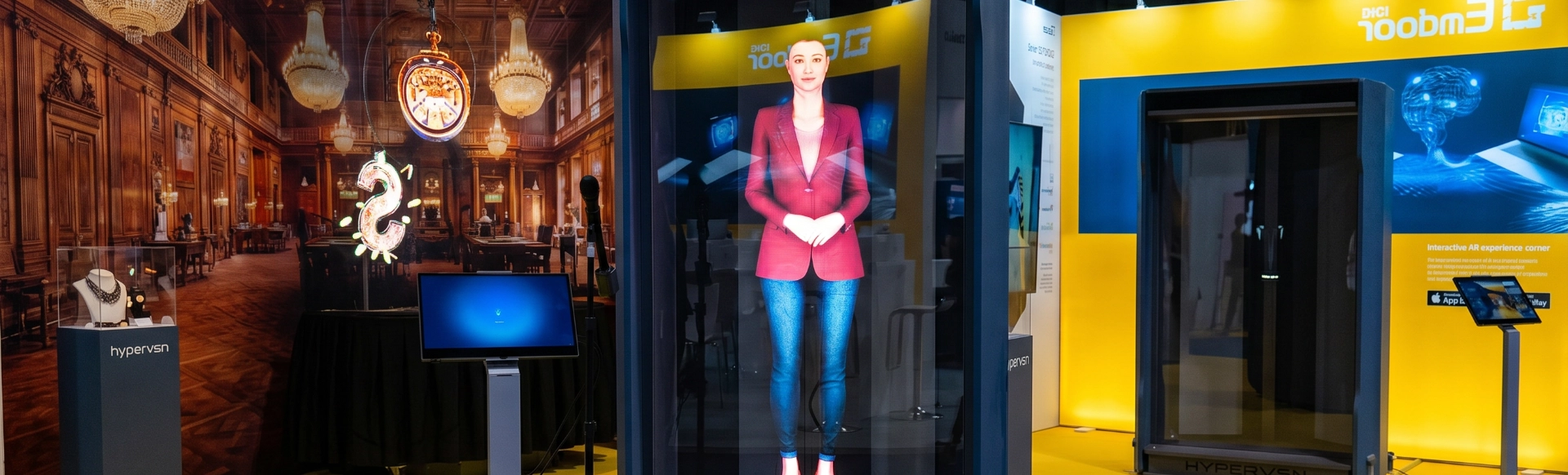
A hologram AI assistant is exactly what it sounds like a life-size projected figure that listens, understands, and talks back in real time. And at GITEX Global 2025 in Dubai, one of them caused something that no branded booth activation, no LED wall, and no giveaway could: a queue that formed on its own and didn't stop.
The booth belonged to LEANGLE. They had deployed an AI Digital Human Holographic Pod a projected figure that moved, responded, and felt, in the words of people standing there, "alive." Nobody announced it as a stunt. The queue just happened.
That moment is a useful lens for understanding where holographic AI assistants actually are right now not in the distant future, not at the bleeding edge of some R&D lab, but on the event floor in your city, quietly making brand reps and wayfinding staff look a little obsolete.
What a Hologram AI Assistant Actually Is (And What It Isn't)
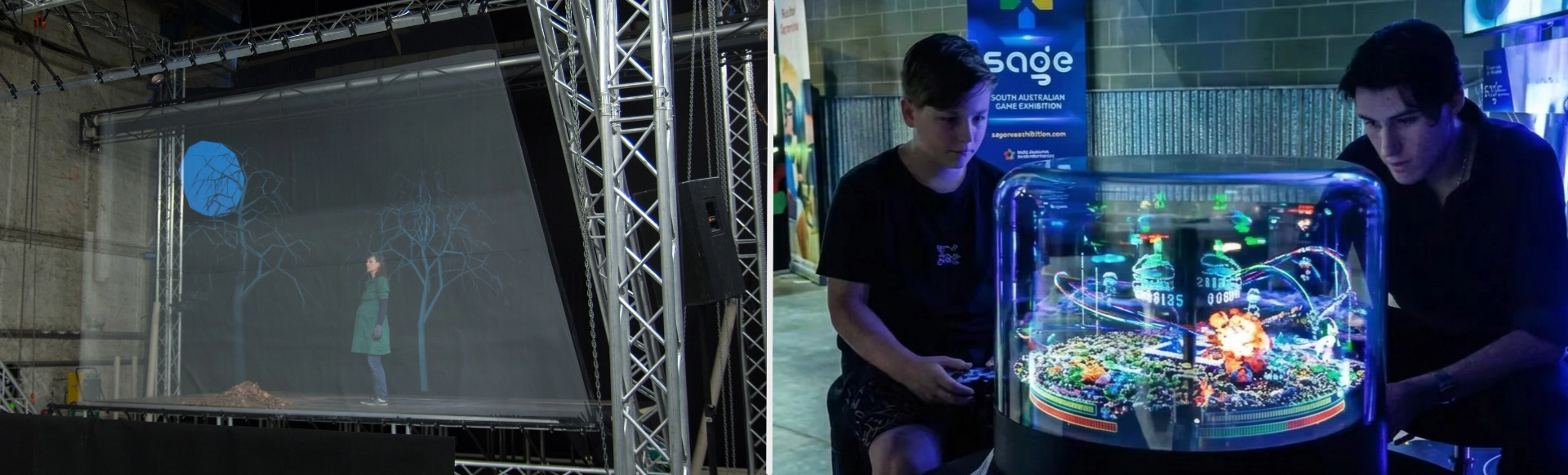
Here's something the industry doesn't shout from the rooftops: the overwhelming majority of what you've seen marketed as a "hologram" at events including those impressive full-body projections is not a hologram in the technical sense. It's a variation of a trick invented in 1862 by a British showman named John Henry Pepper.
Pepper's Ghost works by bouncing a reflected image off a sheet of transparent film or glass positioned at a 45 degree angle. The audience sees the reflection but perceives it as a three-dimensional presence floating in mid-air. It's elegant, effective, and spectacularly convincing. It's also, in principle, a Victorian stage illusion.
Now here's why this matters and also why it doesn't.
It matters because there's a difference between what's being sold and what's technically real. True volumetric holograms light-field displays that produce a genuine 3D image without any screen are still commercially limited. Avalon Holographics only released the first commercially available true holographic table display, NOVAC, in mid-2025.
It doesn't matter because for an event audience, the experience is identical. When e& UAE deployed a hologram AI assistant at GITEX using an HD intelligent display system capable of conducting real-time conversations with visitors, nobody in the crowd was running optical physics calculations. They were just talking to it.
The distinction is worth understanding if you're making a procurement decision. It's irrelevant if you're an attendee trying to get directions to Hall 7.
How AI Turned a Display Into a Conversation
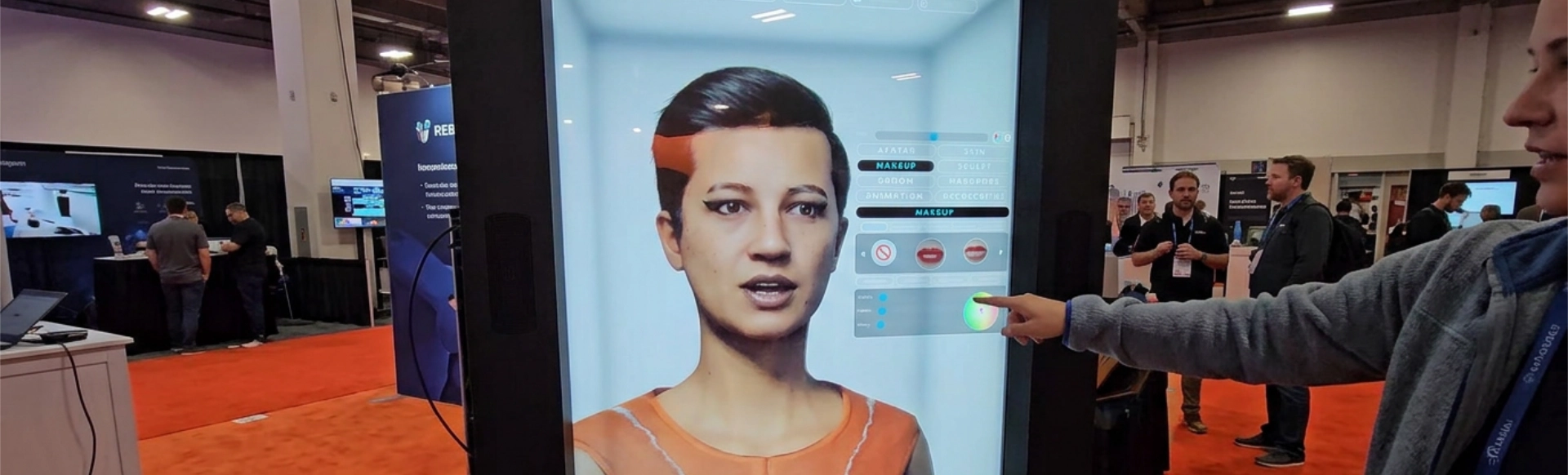
What's genuinely new isn't the optics. It's what's driving the figure inside the display.
Early holographic activations at events were pre-recorded loops a 3D presenter delivering the same pitch every 90 seconds, like a very expensive GIF. They looked striking. They couldn't answer a single question.
The shift happened when large language models became fast enough and cheap enough to run in real-time inside these systems. Today's AI hologram assistant from platforms like HumanBeam and Holoconnects pairs the optical display with a conversational AI that listens, processes, and responds in natural language, usually within a second or two. Think of it as a digital human concierge: always available, always on brand, never on a break.
According to HumanBeam's enterprise deployment data from CES 2026, their holographic AI platform operates in 28 languages simultaneously. In a country like the UAE, where over 200 nationalities share the same event floors and shopping malls, that isn't a nice-to-have feature. It's the entire value proposition. An interactive hologram at a government pavilion in Abu Dhabi that switches from English to Arabic to Hindi mid-conversation without anyone touching a language setting is a fundamentally different tool from what existed three years ago.
The deeper technical challenge that rarely gets discussed is lip sync under load. When an AI holographic assistant is handling hundreds of queries simultaneously, the synchronisation between the AI's spoken response, the animated figure's mouth movement, and the audio output has to happen within milliseconds. Drift even 80 or 100 milliseconds collapses the illusion immediately. This is why edge computing infrastructure matters far more in these deployments than the display hardware itself. The projector is almost the last thing you need to worry about.
The Engagement Numbers Are Hard to Ignore
The commercial case has started to accumulate in ways that make it harder to dismiss.
According to FactMR's 2025 market analysis, the global AI holographic assistant market was valued at $842 million in 2025 and is projected to reach $6.35 billion by 2035 a compound annual growth rate of 22.4%. That's not the trajectory of something being cautiously evaluated. That's a market in the middle of a land grab.
More telling are the on-the-ground engagement figures. According to deployment data reported by Hologram Media Network (HMN), their rollout of 50 AI holographic units across 50 US malls in 2025 produced an average dwell time increase of 32% compared to standard digital signage. Dwell time is the event industry's proxy for real attention it's the closest measurable equivalent to "did this person actually care?" A 32% lift isn't marginal. It's the kind of number that ends a budget conversation.
For context: a human brand ambassador can handle one conversation at a time. A hologram AI assistant handles hundreds simultaneously, at the same quality, in any language. The cost-per-interaction arithmetic shifts dramatically once you run it out over a three-day exhibition.
Why UAE Brands Have a Specific Advantage Here
The UAE's event landscape has characteristics that make AI hologram assistants disproportionately powerful compared to almost any other market in the world.
First, the audience density. Dubai and Abu Dhabi host some of the highest-footfall events on the planet GITEX, ADIPEC, World Government Summit, Cityscape. These aren't niche industry shows. They're global stages with mixed-language audiences, high expectations for novelty, and buyers who respond to spectacle with serious purchasing intent.
Second, the government technology appetite. The UAE Vision 2031 roadmap explicitly frames AI deployment in public-facing services as a national priority. Several federal and emirate-level entities have already piloted AI holographic interfaces at public touchpoints UAE's hologram customer service avatar at GITEX being one of the most visible examples. When a government entity deploys a technology, every corporate exhibitor at the next event wants to match it. The adoption curve in UAE compresses faster than anywhere else.

Third and this is the angle that often gets missed Arabic language support at the level required for genuine conversation is genuinely hard. Most conversational AI was built English-first. The systems that handle Gulf Arabic dialects with any real fluency are a subset of an already small field. Brands that lock in multilingual hologram AI assistant deployments now, before this gets crowded, are building a differentiation that takes years for competitors to close.
At Ortmor, the hologram projects we've built for clients in the region are increasingly being asked to do one thing that wasn't in the original brief a few years ago: talk back. The shift from display to dialogue is happening faster than most event budgets have caught up with. If you're planning a major activation in the next 12 months and a holographic AI assistant isn't in the conversation, it probably should be. You can explore how experiential marketing and immersive tech intersect in the UAE context, and see live project examples at Ortmor ArtLab.
What Nobody Tells You Before You Deploy One
After working in immersive technology across the region, there are a few things that rarely show up in the vendor deck.
The hardware is the easy part. The display enclosure, the projector spec, the cabinet size you'll sort all of that in week one. What takes time is training the AI's knowledge base. A hologram AI assistant that confidently answers "where is Gate C12?" or "what's the price of the Platinum package?" requires someone to have fed it accurate, up-to-date information about your event, your brand, and your FAQs. That content work is not glamorous, and it's where most activations either shine or quietly disappoint.
Placement drives everything. Holographic displays are highly sensitive to ambient light. A stunning activation in a well-controlled indoor environment becomes invisible next to a sunlit glass façade. Experienced AV and production teams understand this. First-timers often don't, and the first sign of trouble is usually on setup day.
Your audience will stress-test it. This isn't a problem it's actually the point. People at events actively try to break AI systems, ask them unexpected questions, speak in their own dialects. Systems that handle this gracefully create the GITEX effect: the organic queue. Systems that don't become awkward demos that staff quietly steer people away from. Testing your holographic AI assistant against your specific audience's language and query patterns before the event is non-negotiable.
Conclusion
The honest version of where AI hologram assistants stand in 2026 is this: the technology works, the engagement data is real, and the market is moving fast enough that early adoption still carries meaningful advantage — especially in the UAE, where events are global in scale, audiences are multilingual, and the expectation for innovation is genuinely high.
The GITEX queue wasn't a fluke. It was a preview of what a well-deployed hologram AI assistant does to foot traffic when everything is set up correctly. The organisations that understand the full stack the AI training, the environment, the language layer, the audience will build experiences people talk about for months. The ones that treat it as a display upgrade won't.
If you want to understand what this looks like in practice for your next event or brand activation, Ortmor's hologram team in UAE can help.
Frequently Asked Questions
Q: What is a hologram AI assistant?
A: A hologram AI assistant is a life-size projected digital figure powered by a real-time conversational AI model. It can listen to questions, process them through a large language model, and respond in natural language — typically within one to two seconds — with a lip-synced animated figure. Most deployments use Pepper's Ghost optical technology or transparent OLED displays to create the 3D presence effect, combined with cloud or edge AI infrastructure for the conversation layer.
Q: Can a hologram AI assistant speak multiple languages?
A: Yes — advanced platforms like HumanBeam can operate in up to 28 languages simultaneously, switching mid-conversation without any manual input. For events in the UAE, where audiences span Arabic, English, Hindi, Tagalog, and many other languages, multilingual capability is one of the key reasons hologram AI deployments are growing faster in the Gulf than in most Western markets.
Q: How much does it cost to deploy a hologram AI assistant at an event?
A: Costs vary based on display hardware, enclosure size, AI knowledge base complexity, and event duration. Entry-level holobox rentals can start at a few thousand dollars for a short activation, while fully custom deployments with branded AI training and immersive staging at large-scale events can reach six figures. The more meaningful calculation is cost-per-interaction: a hologram AI assistant handles hundreds of simultaneous conversations without additional staffing cost, which changes the economics significantly compared to human brand ambassadors.
Q: Is a hologram AI assistant a real hologram?
A: In most commercial deployments today, no — not in the physics sense. The majority use Pepper's Ghost or transparent OLED display technology to create a convincing 3D illusion. True volumetric holograms (where light itself forms the 3D image without any screen) only became commercially available in limited form in mid-2025. For event and brand purposes, the practical distinction rarely matters: the audience experience is indistinguishable from what most people call a hologram.
Q: Where can I get a hologram AI assistant in Dubai or the UAE?
A: Several creative technology agencies in the UAE offer hologram AI assistant deployments for events, brand activations, and permanent installations. Ortmor Agency is a UAE-based hologram company that designs and delivers AI-powered holographic experiences for government entities, large exhibitions, and corporate brands across Dubai and the GCC. Deployments range from single-event holoboxes to permanent interactive installations.
Q: What industries and events are using AI hologram assistants right now?
A: Corporate events, retail, hospitality, healthcare, and government are the leading sectors. Verified deployments include e& UAE's hologram customer service avatar at GITEX, LEANGLE's AI Digital Human Pod at GITEX 2025, and Hologram Media Network's 50-mall rollout across the US. In the GCC, government entities and major brand activations are increasingly incorporating holographic AI assistants into conference and exhibition environments.
Sources & References
-
AI Holographic Assistant Market Size and Share Forecast Outlook 2025 to 2035 — FactMR (2025)
-
Holographic Display Market Size, Growth Outlook 2025–2034 — GM Insights (2025)
-
Proto Hologram — December 2025 Newsletter — Proto Hologram Inc. (2026)
-
GITEX 2025 Highlights: Immersive AI and Emotional Tech Innovations — Khaleej Times (2025)
-
Conversational AI Holograms Solve the Engagement Problem — HumanBeam (2025)
-
CES 2026: How HumanBeam Turned AI Holograms Into a Traffic Magnet — HumanBeam (2026)
-
Glancing into Tomorrow at GITEX: e& UAE's Vision for a Smarter, AI-powered Future — AAP/e& UAE (2024)
-
Hologram Media Network Mall Deployment Data — Proto Hologram / HMN (2025)