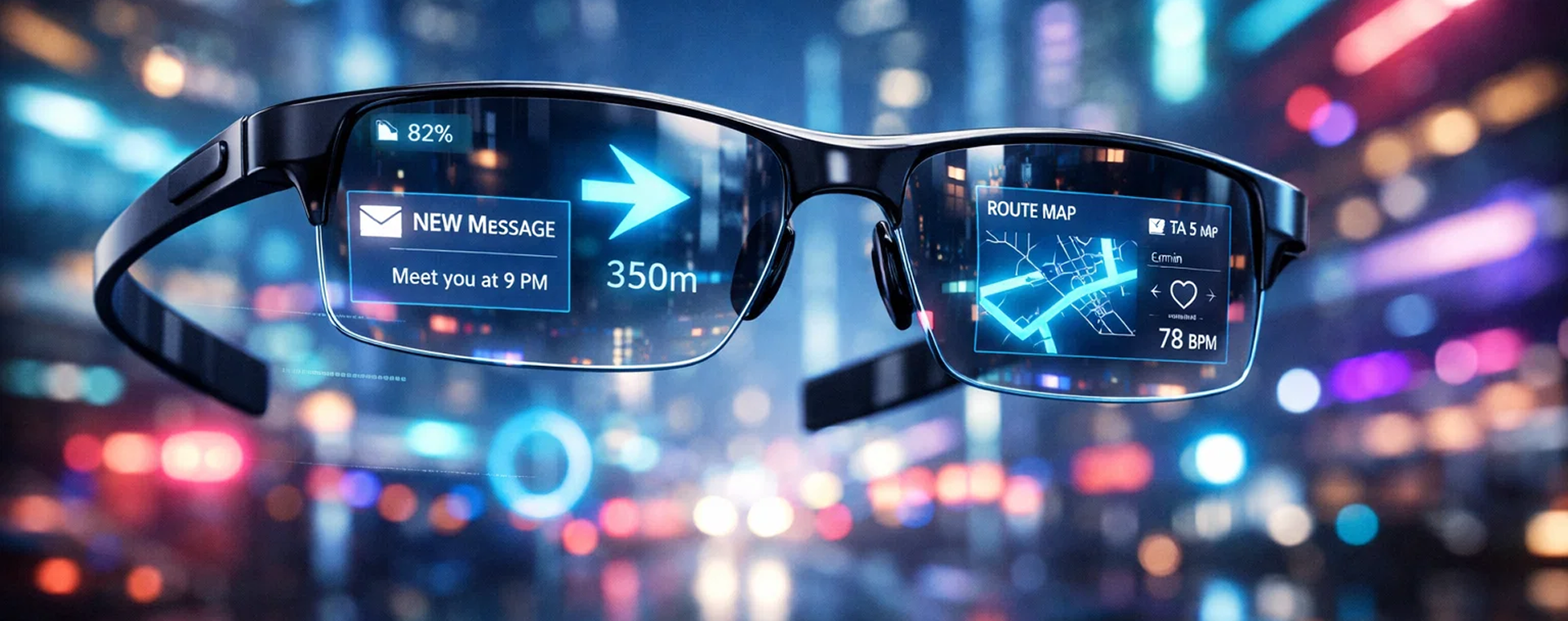
How 3mm Holographic AR Glasses Will Change Reality
Imagine slipping on a pair of glasses no thicker than your average sunglasses lightweight, elegant, and quietly powerful enough to project your messages, maps, and memories right before your eyes. No bulky headsets. No awkward hardware. Just a 3 mm lens that blurs the line between the physical and digital world. That’s the promise of holographic AR glasses a leap that could redefine how we live, work, and see the world around us.
From Sci-Fi Dream to 3 mm Reality
For years, augmented reality felt like a promise stuck in the prototype stage too bulky, too dim, too impractical. But the story is changing fast. Advances in waveguide holography and optical miniaturization have pushed AR hardware from the lab to the lens.
Today, leading optical manufacturers are producing ultra-thin mixed reality displays that are less than 3 mm thick slim enough to look and feel like a normal pair of glasses. This isn’t just a design milestone; it’s an engineering revolution. Inside that wafer-thin lens lies a complex optical sandwich: micro-projectors, reflective layers, and diffractive gratings that channel light directly into your eyes. Think of it as a holographic teleport for pixels bending light to make digital content appear naturally integrated into the world around you.
The Technology Beneath the Glass
At the heart of these next-gen AR wearables lies waveguide holography a technology that guides light through the lens and projects it as crisp, floating images in your field of view.
Traditional AR headsets used mirrors, prisms, and bulky projectors, which made them heavy and power-hungry. Waveguides changed everything. By embedding microscopic structures within the glass, they allow light to bounce internally until it reaches your eye, creating the illusion of depth and presence. Pair that with microLED or laser beam scanning displays, and you get an image that’s sharp, bright, and visible even in sunlight. That’s the holy grail AR engineers have been chasing for a decade clarity, comfort, and compactness all at once.
Why 3 mm Changes Everything
Three millimeters. That’s all it takes to turn science fiction into something you can actually wear. Until now, AR glasses have felt more like prototypes than products bulky, awkward, and anything but subtle. But imagine all that power live directions, instant info, real-world overlays folded into lenses as thin as a credit card. That’s where the magic begins.
When holographic AR glasses become this slim, they stop looking like gadgets and start feeling like part of you. You’ll slip them on in the morning like sunglasses and forget you’re wearing the future on your face.
Power, Comfort, and Connection
How does so much tech fit into something this slim? By moving the heavy lifting off the glasses. Most ultra-thin mixed reality displays pair wirelessly with a phone or a small compute pack. That companion handles processing, AI, and networking. The glasses focus on what they do best: optics, motion sensing, and display. This split keeps the frames light, cool, and comfortable. With better batteries and efficient microLED engines, all-day use moves from wishful thinking to a realistic goal.

Everyday Magic: Simple Uses You’ll Actually Want
AR has been tried before, but it often felt like a gimmick. This new wave is quieter and more useful. Holographic AR glasses focus on helpful, simple actions not flashy effects.
-
Easy navigation: Small arrows appear in front of you, showing where to turn. No phone in your hand.
-
Live translation: As someone talks, short subtitles appear near their mouth. You understand instantly.
-
Fitness and health: While you jog, you see your pace and heart rate at the edge of your view.
-
Work anywhere: Look at a building and see quick project notes. Join a meeting without touching your phone.
-
Better accessibility: For people with hearing loss, live captions turn speech into clear text.
All of this adds helpful info to the real world without blocking what you see or getting in the way.
The Design Evolution of AR
Early AR headsets were powerful but bulky like wearing a desktop on your face. 3 mm holographic AR glasses are the smartphone moment: personal, portable, and stylish.
Design teams are aiming for a clean look: slim temples, thin bezels, and lenses that pass as everyday eyewear. They focus on three things weight, visibility, and heat because every gram and every degree matter.
What’s next is smarter comfort. Electro-chromic lenses will auto-tint in bright sun and gently darken behind digital overlays, so text stays clear outdoors. The result is a seamless, ultra-thin mixed reality display that adapts to your world.
Why This Matters for the Future of Mixed Reality
AR won’t win by adding more effects. It will win by removing effort. People don’t want a separate “digital world” they want helpful info that blends into real life.
That’s what next-gen AR wearables promise: show the right detail, at the right moment, in the right place. When the tech stops shouting and simply follows your intent, it fades into the background and becomes part of how you move, work, and see.
Final Thoughts
The future of AR won’t arrive with a bang it’ll slip quietly onto our faces. 3 mm holographic AR glasses represent more than a hardware upgrade; they mark a shift in how we experience technology itself. When the digital world no longer feels separate but naturally woven into what we see, it stops being a tool and starts becoming a companion.
This is the point where innovation meets intuition,where information appears only when it’s needed, and disappears the moment it’s not. It’s not about seeing more screens; it’s about seeing smarter. The leap to ultra-thin mixed reality displays is the beginning of that transformation. Soon, the future won’t live in our pockets or on our desks it’ll live right in front of our eyes, quietly shaping how we think, connect, and move through the world.