Holographic Displays Are Redefining Retail and Exhibitions in the UAE
The retail landscape is changing and in the UAE, it is changing faster than anywhere else on earth. The global holographic display market reached USD 3.4 billion in 2024 and is growing at 25.2% CAGR through 2034, driven largely by demand from retail, exhibitions, and brand marketing. For brand managers and CMOs operating in one of the world’s most competitive commercial environments, that growth curve tells a clear story: holographic display technology has moved from novelty to strategic necessity.
In a market where Dubai Mall alone attracts over 100 million visitors annually, and where brands at Cityscape, GITEX, and government exhibitions compete for seconds of attention, the question is no longer whether to adopt immersive technology it is whether you can afford not to. This guide covers the use cases driving real adoption, the ROI metrics that justify investment, and the UAE-specific deployments that are setting the benchmark.
Why Holographic Display Is Taking Over UAE Commercial Spaces
The UAE’s ambition to lead in global innovation anchored by Vision 2031 and Abu Dhabi’s economic diversification roadmap has produced a retail and exhibition ecosystem that actively rewards cutting-edge experience design. Government tenders, luxury brand activations, and mega-mall operators are all pushing in the same direction: engagement that earns attention, not just footfall.
Traditional static displays and even LCD video walls are losing the battle for relevance. According to GM Insights, retail and exhibition venues captured 29.2% of global holographic display revenue in 2024 the largest single commercial segment as operators sought to distinguish the in-person brand experience from e-commerce. The International Retailers Association projects that 35% of global retail companies will have implemented holographic displays by 2025, with deployment concentrated in high-traffic malls and flagship stores in innovation-forward markets.
EXPO 2020 Dubai proved a watershed moment for immersive technology adoption across the GCC. Pavilions from more than 190 countries used holographic content as a default medium for national storytelling — normalising the technology for brand teams, government entities, and event agencies throughout the region. The legacy of that normalisation is visible today in how UAE brands approach product launches, retail design, and exhibition stand strategy.
Use Cases That Are Delivering Results in the UAE
Product Launches
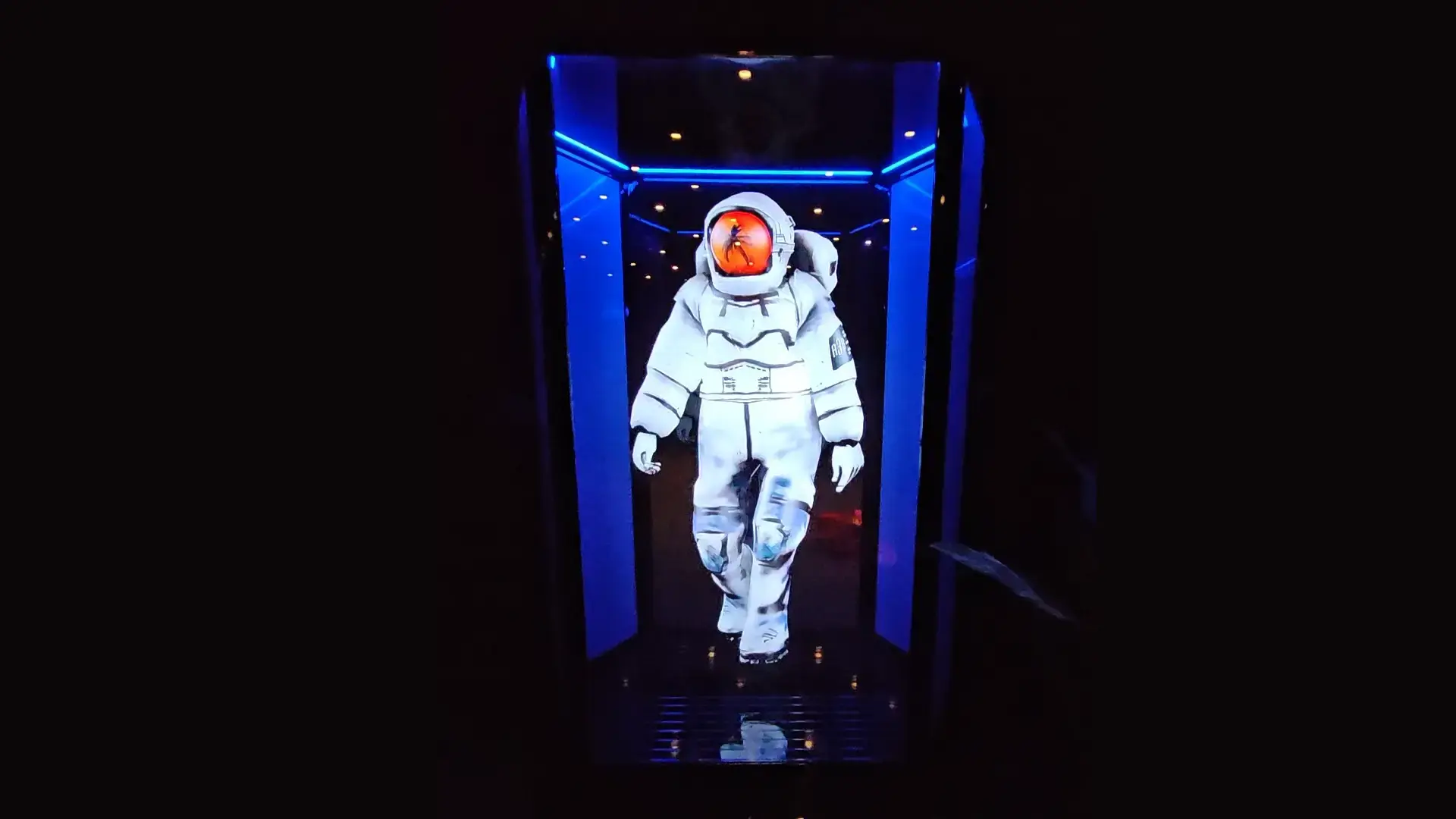
Traditional product launch formats a drape drop, a stage reveal, a video reel are being outpaced by immersive alternatives. Leading brands in the UAE now use stage-sized holographic projections to present products in three dimensions before a live audience, without requiring the physical item to be transported or staged. Automotive brands have used full-scale vehicle holograms at Dubai venue launches, enabling 360-degree audience viewing from every angle. Luxury fashion houses deploy Holocubes enclosed display cases that combine physical objects with animated 3D holographic imagery at flagship retail events, generating social content as a byproduct of the activation.
Toyota and Sobha are among the brands that have deployed stage-sized holograms for UAE event activations, while Vodafone UAE and Dubai Municipality have used holographic fan arrays for public-facing awareness campaigns — demonstrating the technology’s reach from commercial enterprise to government communications.
Mall Activations
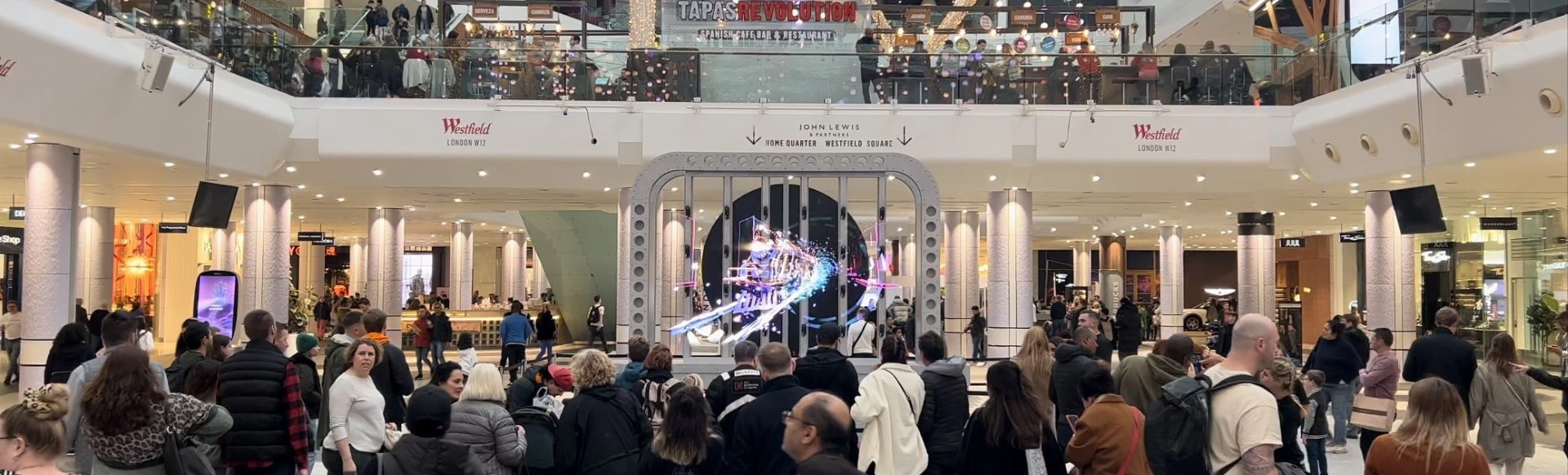
Shopping malls are the experiential battleground of UAE brand marketing. Holographic fan arrays clusters of high-speed LED propellers that project seamless 3D animations in mid-air are appearing in atriums, anchor zones, and food and beverage courts across Dubai and Abu Dhabi. Brands deploying holographic displays in high-traffic mall zones report dwell-time lifts of up to 40%, converting organic foot traffic into genuine, sustained brand attention.
These activations also serve a competitive positioning function. With Majid Al Futtaim allocating USD 1.36 billion to upgrade Mall of the Emirates, and Emaar’s Dubai Square at Creek Harbour being designed as a technology-forward retail destination, mall operators are prioritising tenants and brand partners who bring experiential value. A well-executed holographic activation strengthens a brand’s standing in premium UAE retail environments well beyond its activation window.
Airport and Transit Displays
Dubai International Airport the world’s busiest international airport is a high-value brand touchpoint for global and regional names. Holographic display panels in departure lounges, transit corridors, and duty-free zones convert idle wait time into immersive brand exposure, reaching audiences at a moment of relative stillness and receptivity. Government and national entities also deploy holographic airport installations for destination marketing: showcasing cultural assets, tourism campaigns, or Vision-aligned messaging to tens of millions of international visitors annually. The format commands attention in environments where conventional digital signage has become background noise.
The Business Case: What ROI Actually Looks Like
The question every marketing director asks is legitimate: what does a holographic display activation actually return? The commercial data is becoming harder to dismiss.
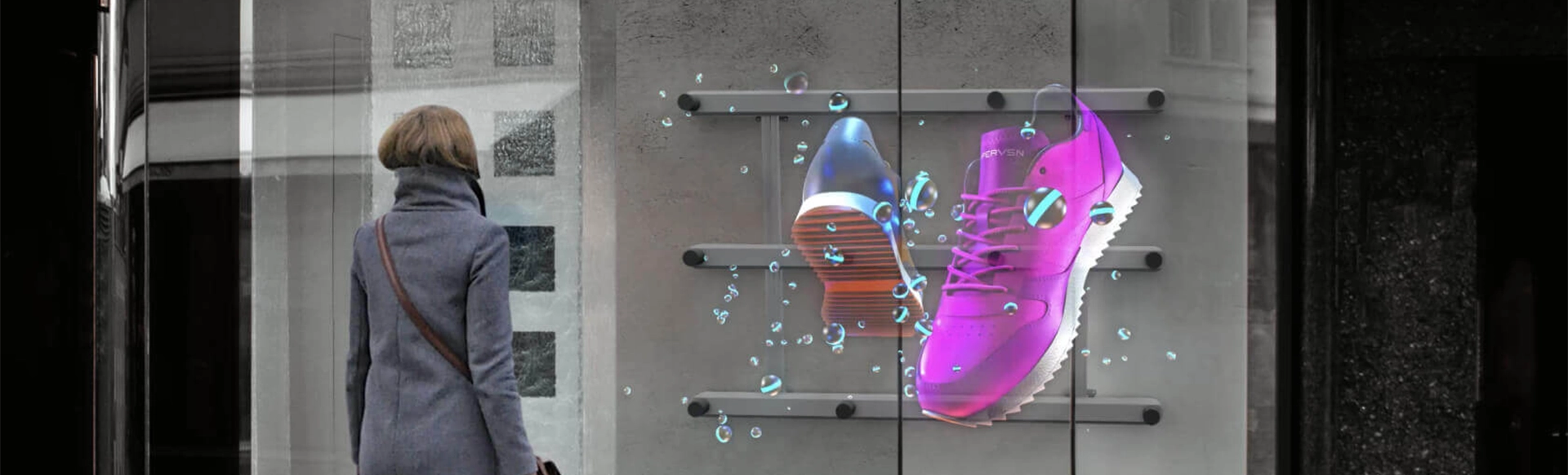
Retail deployments are producing documented outcomes. Kellogg’s recorded a 60% increase in Special K cereal sales in French stores following the introduction of holographic shelf advertising a direct, trackable sales uplift from a single display change. Across retail environments more broadly, holographic showcase deployments report up to 40% increases in product sales and viewer engagement lifts of 40%, according to GM Insights market analysis of commercial deployments in 2024.
Beyond conversion, holographic displays generate earned media value that compounds the investment. A striking mall activation becomes a social trigger visitors photograph and share it, extending brand reach across Instagram and LinkedIn at no incremental cost. In UAE markets where social media penetration is among the highest globally, this organic amplification represents a material component of campaign ROI.
The attention differential with conventional digital signage is also well-established. Standard digital signage earns 2–3 seconds of average glance time. A well-designed in-motion holographic display holds viewer attention for 8–12 seconds a 4–6x improvement in sustained engagement that translates directly into brand message retention.
What Holographic Display Delivery Looks Like With Ortmor
Ortmor Agency has deployed holographic display technology across retail, government, and exhibition environments in the UAE and wider GCC. Capabilities span standalone Holocubes for luxury product showcases through to multi-unit holographic fan arrays engineered for large-format mall atriums and international exhibition halls.
As a full-service hologram company in the UAE, Ortmor manages the complete delivery pipeline from concept development and 3D content production through to hardware procurement, installation, calibration, and on-site activation support. Brand teams receive a single point of accountability rather than a patchwork of suppliers.
For government entities and major brands scoping exhibition activations whether for GITEX, Cityscape, the Abu Dhabi International Book Fair, or bespoke brand launches — Ortmor’s experiential marketing services integrate holographic technology with spatial design, real-time interactive content, and full event-production infrastructure. Explore deployed examples through Ortmor’s case studies
Conclusion
The UAE’s position as a global benchmark for experiential retail and exhibition innovation is the product of deliberate investment in brand environment technology and holographic display sits at the centre of that shift. The market data, the documented ROI metrics, and the pattern of adoption across UAE malls, product launches, airports, and government exhibitions all point in the same direction: this technology delivers measurable engagement, documented sales uplift, and the kind of visual impact that earns organic attention in even the most competitive commercial environments.
For marketing directors and brand teams evaluating where to invest in physical brand presence in 2026, the decision is increasingly straightforward. The more interesting question is whether the agency building the experience has the creative depth and technical precision to make it unforgettable. Talk to Ortmor [link: ortmoragency.com] to scope your next holographic activation.
Frequently Asked Questions
Q: What is a holographic display and how does it work?
A: A holographic display is a technology that creates the visual perception of three-dimensional images appearing to float in space, without requiring the viewer to wear glasses or headsets. In commercial retail and exhibition settings, the most common formats are holographic fan arrays, Holocubes, and large-format Pepper’s Ghost projection systems for staged brand events.
Q: How much does a holographic display cost in the UAE?
A: Entry-level holographic fan units typically begin in the AED 5,000–15,000 range for hardware alone, with 3D content production costs in addition. Large-format mall and airport installations are scoped as full projects and can range from AED 50,000 into the hundreds of thousands.
Q: What industries use holographic displays most in the UAE?
A: Retail and exhibitions capture the largest share, followed by automotive, luxury goods, real estate, and government and tourism entities. Healthcare, financial services, and education are emerging verticals.
Q: Can a holographic display be used outdoors in UAE conditions?
A: Semi-outdoor environments with shade structures are suitable for high-brightness fan arrays. Fully open outdoor use is not recommended: direct sunlight dramatically reduces image visibility and UAE temperatures affect hardware operating parameters.
Q: What ROI can brands expect from holographic display activations in the UAE?
A: Documented outcomes include 40% viewer engagement lifts, up to 40% product sales increases, and Kellogg’s 60% sales uplift from holographic shelf ads. Holographic displays hold viewer attention for 8–12 seconds vs 2–3 seconds for standard signage a 4–6x improvement that directly influences message retention.
Sources & References
1. Holographic Display Market Size, Growth Outlook 2025–2034 — GM Insights (2024)
2. Holographic Display Market Share & Report Analysis, 2030 — Mordor Intelligence (2024)
3. AI-powered holographic visualisation at Expo 2020 Dubai — Stereoscape
4. Retail Signage Trends in UAE Malls 2025 — Smerktech (2025)
5. Hologram Technology in the Middle East — AV Plus TV (2024)
6. Daktronics Brings Rings of Entertainment to Life for Dubai Mall — Daktronics (2024)
7. Dubai Square: A New Era of Retail — Dubai Holding / Emaar (2024)