Holographic Telepresence: The Future of 3D Meetings
After years of video calls, the “new normal” of remote work feels flat. We miss the spark of live brainstorming, the reassuring nod across the table, and the sense of truly being together with our teams, partners, and customers.
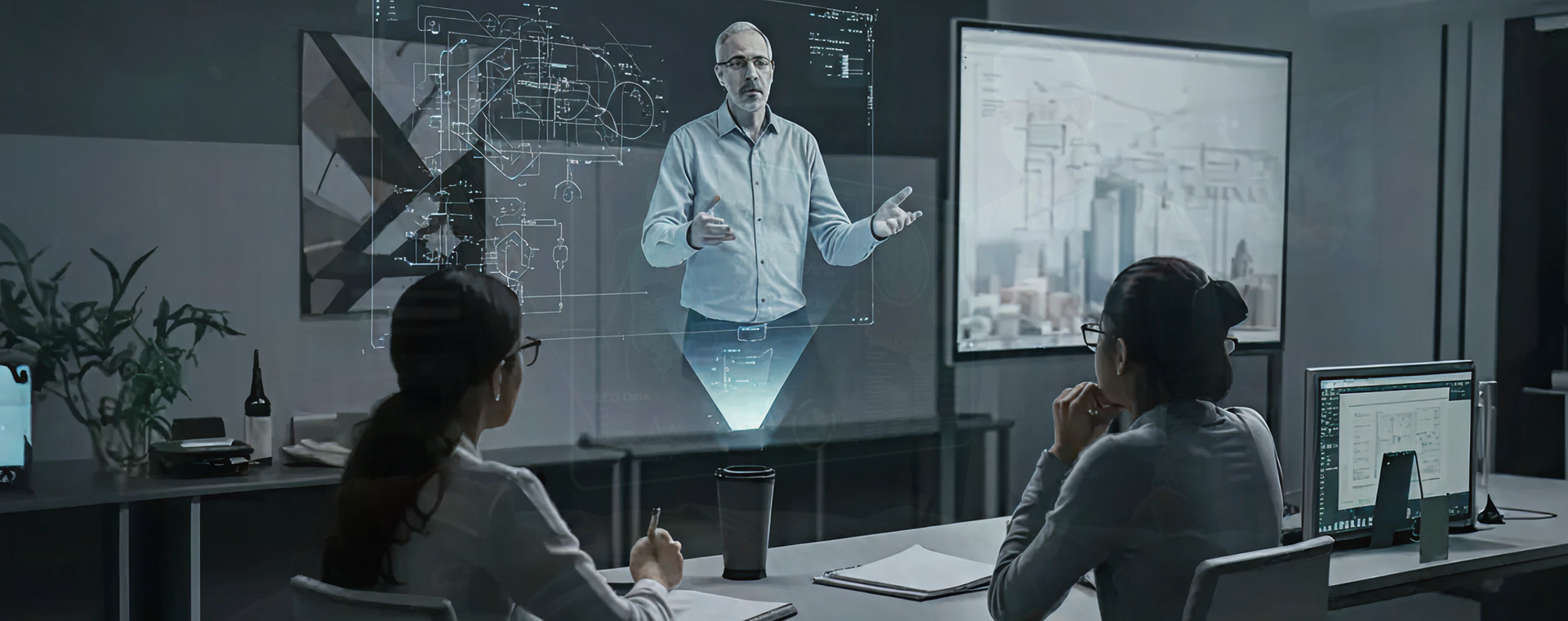
Now the next chapter of communication is unfolding: enter holographic telepresence. This isn’t a buzzword; it’s a practical step forward. With real-time hologram communication, a colleague can appear beside you as a life-size 3D presence, speaking and gesturing naturally, even from the other side of the world.
The future of collaboration won’t live on a 2D screen. It will be immersive remote 3D interaction that restores eye contact, body language, and shared space so work feels human again.
The shift from flat screens to real presence
Holographic telepresence is a breakthrough technology that combines 3D capture and projection in such a way that real-time, life-size figures of people are brought into the room. What if you came to a meeting and a colleague from overseas appeared right next to you as a complete 3D character that not only moved but also gestured and even looked at you just like a human being? The fact that this is made possible by real-time hologram communication, super-fast 5G, and edge computing means that this is no longer just a futuristic idea but an actual application that is being implemented. We are on the verge of a reality where remote 3D interaction is no longer just a simulation of reality but a re-creation of it.
How Holographic Telepresence Actually Works
A variety of cameras take pictures of the same person from different angles and produce a volumetric 3D model that is always updated. Machine learning-powered systems compress and send the data through the network to the place where the data is uncompressed, and light-field panels, hologram pods, or AR and MR glasses display the information. The final output is spatial telepresence, the feeling of digitally sharing the same space as well as physically. Instead of just seeing a person on a screen, you are able to comprehend their posture, arm movements, and even the small pieces of the conversation, which are usually very subtle. This is the reason why holographic telepresence is so important: it is the technology that truly bridges the gap between people, instead of simply being a 'gadget novelty.'
Why it matters: the psychology of presence
Traditional video calls engage your eyes; holographic telepresence engages your instincts. Humans are wired to read spatial cues like depth, proximity, and motion to judge trust and emotion. When you experience real-time hologram communication, your brain stops treating it as a screen and starts treating it as a person in the room.
This is why researchers and companies are investing heavily. Presence is not a feature; it is a feeling. It speeds up idea flow, makes negotiations more natural, and turns collaboration into a shared experience instead of a broadcast. Across business, education, and healthcare, teams are testing remote 3D interaction to build stronger bonds across distance. From boardrooms to classrooms to clinical settings to creative studios, wherever human connection matters, holographic telepresence is finding a role.
Industries Already Embracing the Future
1. Business & Collaboration
In the new hybrid world of work, people are really getting tired of too many video calls. With holographic telepresence, you get the vibe of a face-to-face meeting again, but without all the driving or flying. It’s hard to picture, but holograms can travel at the speed of light! So, your CEO's holographic visit to employees located in different parts of the world is as good as real, and likewise, teams located in different countries can brainstorm as if they are physically present together in the same room. A leadership communication made through a real-time hologram is a technology that gives a sense of closeness and empathy, not the opposite.
2. Education & Training
A professor in London can virtually, as a hologram, go into a classroom in Abu Dhabi and teach live. Pupils can converse and ask questions, and they trust the educators’ virtual presence. In sectors such as aviation, medicine, or engineering, this type of spatial telepresence might be a breakthrough that could open up limitless opportunities for practical learning in any part of the world.
3. Healthcare & Telemedicine
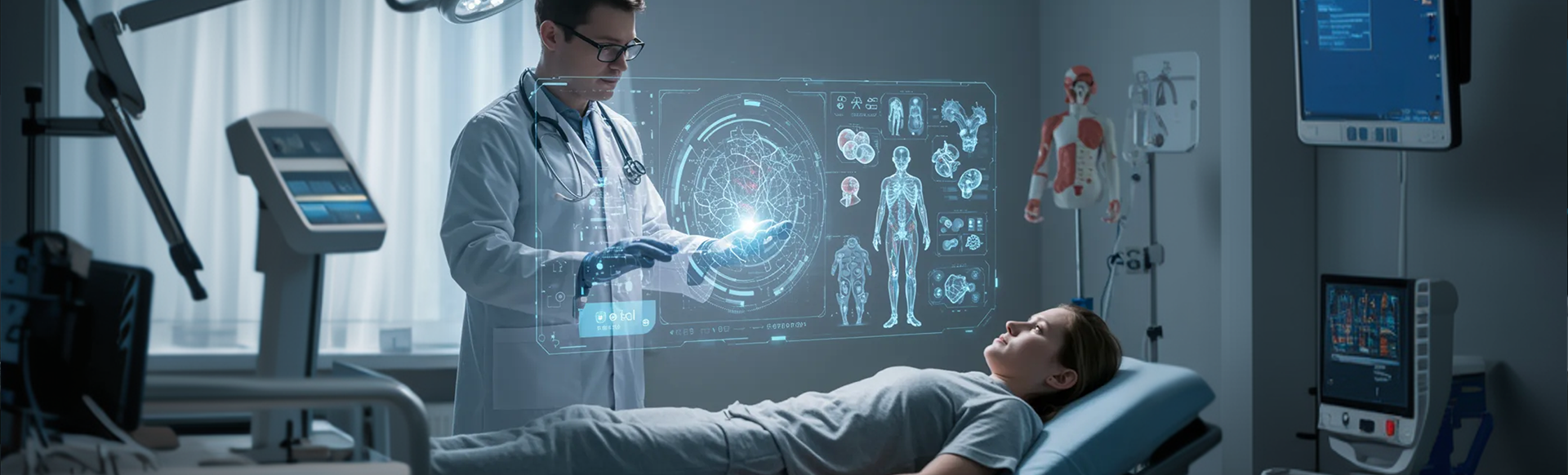
Doctors could be able to remotely perform surgeries or any other interventions on patients in other parts of the globe with the help of a 3D robot. This, usually, is the most personalized, indirect, and fast way of offering help. In contrast to normal video calls, which are two-dimensional, holographic telepresence gives a doctor the opportunity to observe the patient's body movement, performative cues, or medical models in 3D right by the patient, thus helping the doctor to be more empathetic and precise.
4. Entertainment & Media
From holographic concerts to virtual press conferences, artists and public figures can “appear” in multiple places at once. This isn’t about replacing live experiences; it’s about expanding them. A musician performing as a real-time hologram in ten cities at once isn’t distant anymore; they’re omnipresent.
The technology catching up
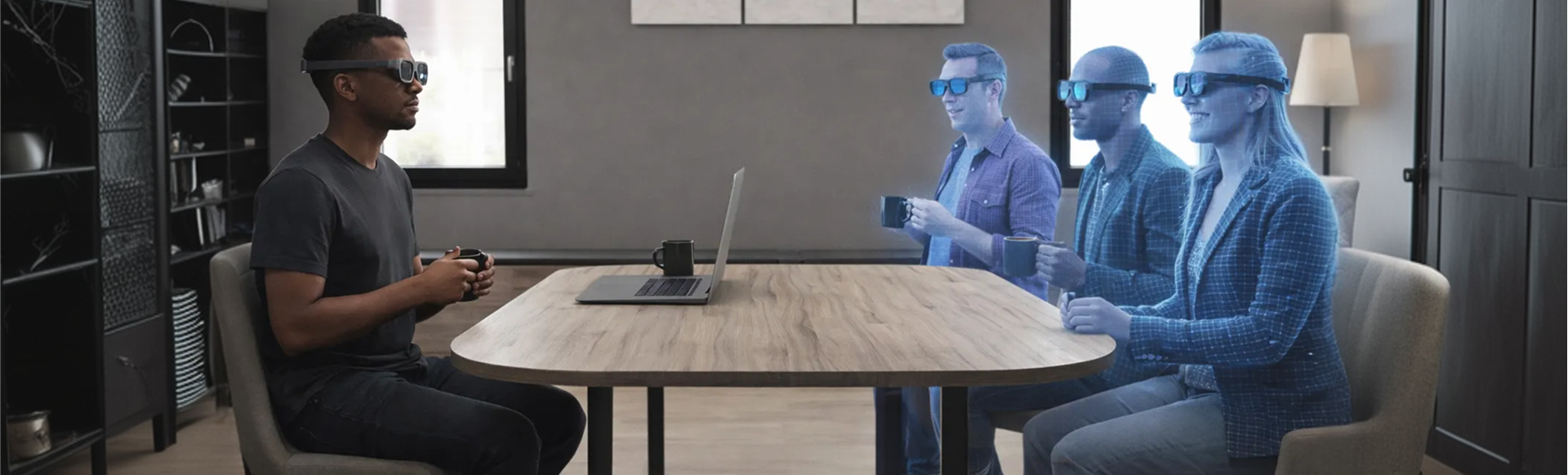
Holographic telepresence is complex, but it’s getting practical fast. Companies such as PORTL, Proto, and ARHT Media already deploy compact hologram pods that project life-size people in minutes. At the same time, Microsoft Mesh and Google’s Project Starline are pushing spatial telepresence with mixed reality and light-field imaging designed to work with everyday devices.
Three enablers make real-time hologram communication feel seamless: AI-driven compression, 5G connectivity, and edge computing. Together they cut latency, improve fidelity, and keep motion and gestures in sync. What once demanded a studio-scale setup now fits into a sleek office pod or a conference wall, bringing holographic telepresence within reach of modern workplaces.
The Barriers Still Standing
We are not fully there yet. Scaling holographic telepresence comes with a few hurdles.
-
Infrastructure demands: You need fast, stable networks that can handle massive 3D data streams.
-
Hardware costs: Volumetric capture rigs and light-field projectors are still premium investments.
-
Interoperability: Not all holographic systems “talk” to each other yet.
-
Accessibility: For now, this level of remote 3D interaction is more common in enterprise or event settings than personal use.
These are temporary hurdles, not permanent blocks. Think about video conferencing. It once needed special rooms and expensive cameras. Now it runs on a phone. Holographic telepresence is moving in the same direction, and the pace is increasing.
The Human Advantage
Beyond the technology, the value is human. Holographic telepresence is not trying to replace face-to-face time. It is trying to bring that feeling back in digital form. People want presence, not just pixels. They want to be seen and felt, not only heard.
As spatial telepresence grows, the line between virtual meetings and real meetings will fade. You will not join a call. You will walk into it. That small shift changes how we negotiate, how we learn, and how we empathize.
What the future holds
In the next five years, expect holographic telepresence to move from corporate showcases to everyday tools. Retail chains will use it for interactive brand ambassadors. Universities will beam in global guest speakers. Medical teams will collaborate on surgeries across continents. Even families could one day celebrate birthdays together in holographic form, seeing and reacting to each other in full 3D.
The convergence of AI, AR, and 5G is accelerating this future. The same infrastructure powering autonomous cars and smart cities will make holographic meetings fluid and lifelike. And once mass adoption begins, costs will plummet the same way flat video went from luxury to necessity.
In short, the technology that once belonged in sci-fi movies is becoming the next workplace standard. Real-time hologram communication isn’t just changing how we connect; it’s redefining where connection happens.
Final Thought
The way we connect is evolving from something we watch to something we feel. Holographic telepresence isn’t just another step in communication; it’s the moment technology finally catches up with our need for real presence. When distance no longer dictates connection, conversations regain their depth, ideas move faster, and collaboration feels natural again.
Your next meeting might not happen on a screen but in a shared space that is alive, dynamic, and real. And when that day comes, it won’t feel like the future. It’ll feel like how communication was always meant to be.