What Is a Hologram? How Holograms Work — And What's Actually Possible in 2026
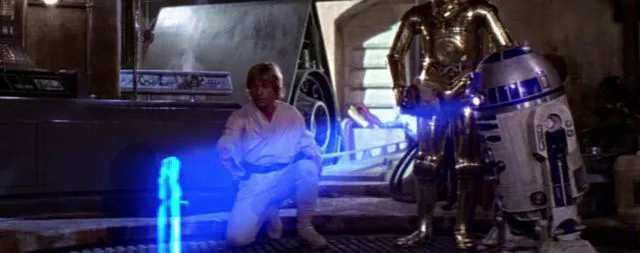
Everyone has seen a "hologram." A spinning fan display at a mall kiosk. Tupac performing at Coachella. Princess Leia's famous distress call flickering out of R2-D2. But here's the uncomfortable truth the industry rarely admits: almost none of what gets called a hologram is actually a hologram. The word has become a marketing term applied to LED fan displays, Pepper's Ghost projections, and smoke screens while the genuine physics of holography remains poorly understood outside the laboratory.
The question "what is a hologram?" generates over 12,100 searches every month globally (Semrush, 2026), yet most of the answers people find describe technology that has nothing to do with true holography. Meanwhile, the holographic display market is projected to grow from $4.63 billion in 2026 to $15.15 billion by 2030, at a CAGR of 26.48% (Research and Markets, 2025). That gap between public expectation and physical reality — is exactly what this article closes.
What Holography Actually Is: The Physics Behind a Real Hologram
The hologram meaning comes from Greek: holos (whole) + gramma (message). A hologram is a photographic recording that captures not just the intensity of light reflected from an object as an ordinary photograph does but also the phase of that light. It is this phase information that makes a hologram genuinely three-dimensional.
Holography was invented in 1948 by Hungarian-British physicist Dennis Gabor, who was awarded the Nobel Prize in Physics in 1971 "for his invention and development of the holographic method" (Nobel Prize Organisation). The technique only became practical after the invention of the laser in 1960, which provided the coherent light source holography requires.
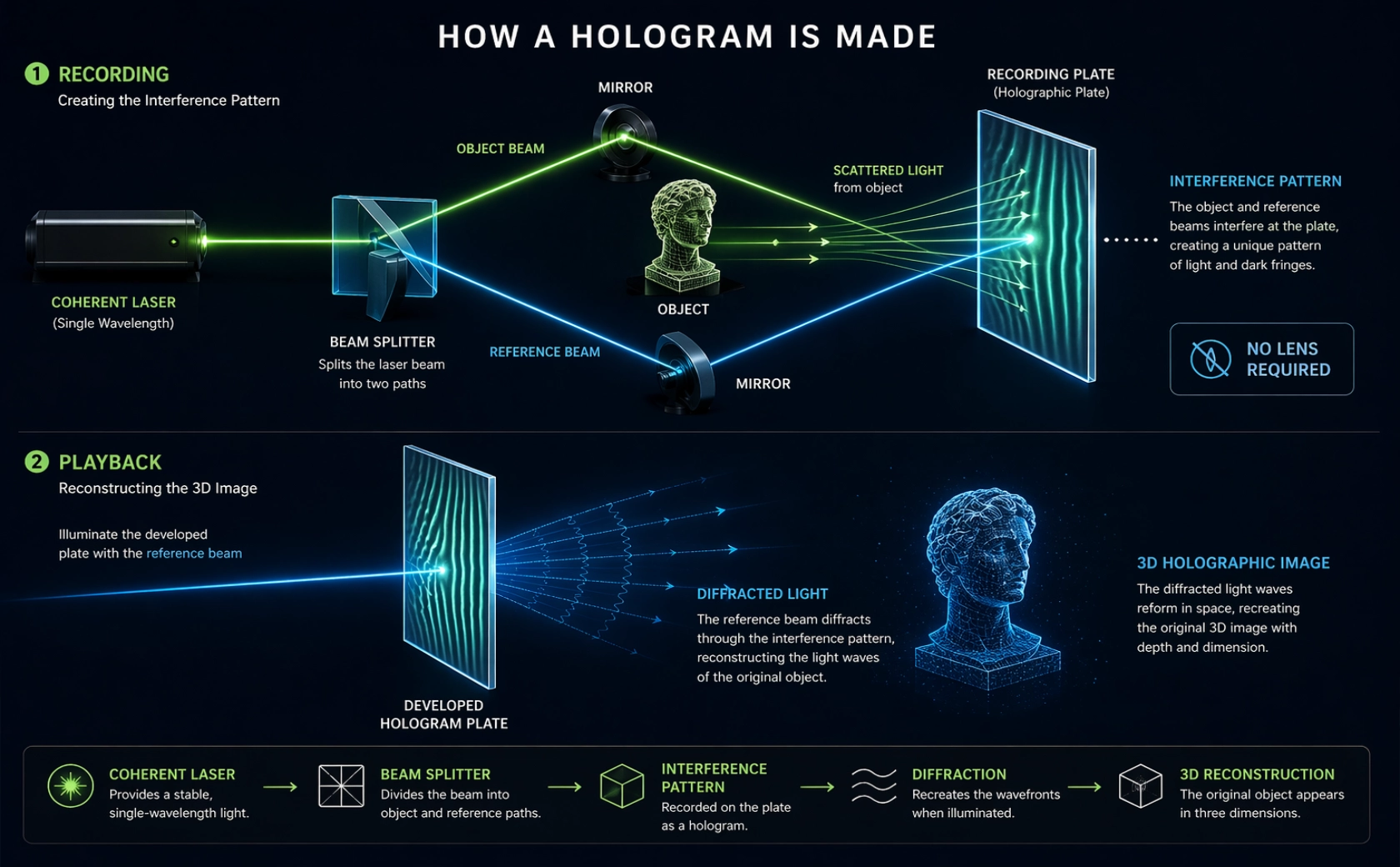
How are holograms made? The recording process works as follows:
A laser emitting coherent light, meaning all photons are perfectly synchronised in phase and wavelength — is split by a half-mirror into two beams:
-
The object beam is directed toward the subject being recorded. Light scatters off every surface of the object in all directions, carrying information about its shape, texture, and depth.
-
The reference beam travels directly to a photosensitive recording medium (a specially coated film or plate) without striking the object.
Where the two beams meet at the recording surface, they interfere. The scattered object beam and the steady reference beam create an intricate pattern of constructive interference (bright fringes, where wave peaks align) and destructive interference (dark fringes, where waves cancel). This interference pattern invisible to the naked eye, looking like a foggy, featureless plate is what gets permanently etched into the film. There is no recognisable image. The information is encoded in the physics of light itself.
Reconstruction is where the hologram becomes visible. Illuminate the developed plate with the same reference beam (or a similar coherent source), and the recorded interference pattern acts as a precise diffraction grating. The light bends through it in a way that recreates the exact wavefront that originally scattered off the object. Your eyes receive that wavefront and interpret it as a three-dimensional image because the light is arriving exactly as it would if the object were truly present in space.
Move your head left or right: you see around the object. Move up or down: the perspective shifts. This is genuine parallax, encoded in physics not a digital trick applied in post-production.
One more remarkable characteristic: cut a hologram in half and you don't lose half the image. Each fragment contains the complete picture, because every point on the recording surface received light from every visible point on the subject.
This holographic principle the whole contained in every part is a direct consequence of how interference patterns work, as described in the OpenStax University Physics Volume 3 (Chapter 4.7) and corroborated by research published in Nature Communications on diffraction-engineered holography (2022).
How a Hologram Is Made
Are Holograms Real? The Six Technologies Sold as "Holograms" (And What They Actually Are)
This is the question 880 people ask Google every month : are holograms real? The answer is yes but what's being sold to you as a "hologram" almost certainly isn't one. Here is the complete taxonomy.
1. LED Fan Displays (HoloFan) The most widespread "hologram" technology on the market today. LED light strips are mounted on the spinning blades of a fan. At sufficient RPM, the brain's persistence of vision the optical phenomenon where an image is retained briefly after it disappears fuses the rapid flashes into what appears to be a glowing, floating image in mid-air.
The content is fully programmable: you can run video, change content remotely, even sync with audio. It is visually striking at trade shows and retail environments. It is not a hologram. It produces a 2D image. The "floating" effect is an illusion that disappears when viewed from off-axis angles. The LED fan hologram remains the dominant technology for entry-level brand activations.
2. Pepper's Ghost This is the technique behind virtually every "hologram" concert you have ever seen. The Tupac Coachella performance (2012). Posthumous shows featuring Roy Orbison, Whitney Houston, Ronnie James Dio, and others. It was first publicly demonstrated by English scientist John Henry Pepper on Christmas Eve, 1862, at a Regent Street Theatre production in London and it caused a sensation.
The principle: a bright image or video is projected onto a surface below or beside the stage. A large, transparent pane of film or glass, angled at 45 degrees to the audience's sightline, reflects that image forward, making it appear to float in the performance space. All the machinery — the screens, projectors, and reflective panel is hidden from view. The result is a ghostly figure that appears to share the stage with live performers. It is a remarkable illusion. It is also 164 years old.
3. Holographic Projection Pyramids (Cheoptics-style) An evolution of Pepper's Ghost using four transparent panels arranged in a pyramid. Video content is projected simultaneously from four directions, bouncing off each panel toward the centre of the enclosure. The result appears to float inside the pyramid and can be viewed from any angle around it — a significant improvement over single-panel Pepper's Ghost. Used extensively for product launches, museum installations, and architectural visualisations. Multiple viewers can experience it simultaneously. It still requires a physical transparent enclosure and precise lighting conditions. Not a hologram.
4. Smoke and Water Projection A smoke machine creates a dense particle curtain; a high-powered projector fires content at it. The airborne particles scatter light, making the projected image appear to hang in space with an ethereal quality ideal for dramatic reveals and brand activations. Water mist works on the same principle — multiple sprinklers create a mist wall, and intense projectors illuminate it from behind. Both are atmospheric and visually arresting. Both are also sensitive to wind and environmental conditions, making them suitable only for controlled indoor venues.
5. Smart Glasses and Augmented Reality Devices like Microsoft HoloLens, Apple Vision Pro, and Magic Leap superimpose digital imagery onto the real world through transparent displays worn on the face. Often described as "holographic" Microsoft even uses that word in the HoloLens product name this is technically Augmented Reality. It shares the experience of holography in the sense that digital objects appear to occupy real space, but the content is visible only to the wearer, limiting its use in public-facing brand experiences and events.
6. Light Field Displays The most technically credible near-hologram available at commercial scale. Companies such as Looking Glass Factory use densely packed lens arrays and high-resolution displays to project approximately 100 different angular views of a 3D scene simultaneously. Viewers positioned around the display naturally see different perspectives as they move true parallax, without headsets. Multiple people can gather around and view simultaneously. It does not use laser interference; it is not holography by the physicist's definition. But it is the closest viewer experience to true holography that exists today outside a research facility.
Volumetric Displays and What Is Actually Possible in 2026
Volumetric display technology represents the genuine frontier and the category where the gap between science fiction and commercial reality is narrowing fastest.
The most advanced demonstration to date involves optical trapping: laser beams manipulate microscopic particles with extreme precision (a technique using optical tweezers), moving them rapidly enough that persistence of vision creates a glowing, screenless 3D shape floating in open air. No surface. No screen. No enclosure. The particles are the image actual physical objects suspended by light, forming a three-dimensional shape visible from any angle simultaneously. Multiple viewers can see it at once, from their own perspective, in real time. Researchers at the University of Sussex pioneered early versions of this approach, and the technique has continued to advance.
The catch: as of 2026, this technology produces images at millimetre scale and exists in controlled laboratory environments. It has not yet crossed into commercial or event deployment at human scale. But the trajectory is clear.
Neural holography is accelerating alongside. In 2024, researchers at Princeton University published advances in AI-optimised algorithms for generating true holographic patterns, dramatically improving image quality and reducing the computational cost required to drive holographic displays. As AI-generated holography matures, the barrier to producing high-fidelity holographic images in real time is dropping.
The digital holography market encompassing these emerging technologies is projected to reach $28.05 billion by 2035 (Precedence Research, 2024). The technology is coming. The honest assessment is that large-scale, free-floating mid-air holograms at human scale are not yet commercially deployable. What exists is remarkable, genuinely advancing, and far more interesting than the industry's casual abuse of the word "hologram" suggests.
What This Means for Live Events and Brand Experiences in 2026
Understanding the distinction between holography and hologram-style displays is not academic pedantry — it is the difference between selecting the right technology for a brief and an expensive disappointment.
A Pepper's Ghost installation can fill an 8,000-seat arena. A 3-metre LED fan display dominates a retail floor with programmable content that can be updated remotely. A holographic projection pyramid gives a product launch an extraordinary reveal moment that multiple VIP guests can gather around.
Light field displays are transforming how architects and product designers present spatial concepts without requiring the client to wear a headset. Each technology has a specific cost profile, viewing angle, ambient light tolerance, and audience size it suits. Deploying the wrong one is a common and avoidable mistake.
At Ortmor Agency, we work across the full spectrum of hologram technology from LED fan hologram arrays for retail activations to large-scale Pepper's Ghost productions for government events and live entertainment across the UAE and GCC. Our ArtLab is where we prototype and test the newest display technologies before they reach client briefs. See what we have delivered in our case studies, or explore how holographic display integrates with our broader experiential marketing services.
The question to ask is never "is it a real hologram?" The question is: "what experience does this audience need, in this space, at this moment and which technology delivers it most powerfully?" That is a question we have been answering for brands and government entities across the region for years.
Frequently Asked Questions
Q: What is a hologram in simple terms?
A: A hologram is a three-dimensional image created by recording the interference pattern of laser light reflected from an object onto a photosensitive surface. Unlike a photograph, which records only the intensity of light, a hologram records both intensity and phase the full wave information.
When illuminated with a laser, it reconstructs the original light field so precisely that you can look around the image as if the object were physically present. True holography was invented by physicist Dennis Gabor in 1948. The term is commonly (and incorrectly) applied to LED fan displays, Pepper's Ghost illusions, and projection systems, none of which involve the actual physics of holography.
Q: How do holograms work?
A: A real hologram works through the physics of light interference and diffraction. A coherent laser beam is split into two paths: an object beam (which scatters off the subject) and a reference beam (which travels directly to a recording medium).
Where they meet, they create an interference pattern a complex arrangement of light and dark fringes that encodes three-dimensional spatial information. When the developed recording is later illuminated with the reference beam, the recorded pattern diffracts the light in precisely the way the original scene did, reconstructing a full three-dimensional image that shows genuine depth and parallax from every viewing angle.
Q: Do holograms exist in real life?
A: Yes, real holograms exist you have almost certainly seen them. The security embossed sticker on your credit card or passport is a true hologram. Museum-quality laser holograms have been produced since the 1960s. What does not yet exist commercially at human scale is the free-floating, screenless mid-air "hologram" depicted in Star Wars.
Technologies such as Pepper's Ghost, LED fan displays, and holographic projection pyramids create convincing three-dimensional illusions, but they are not holograms in the physics sense. Volumetric display research where laser-trapped particles form screenless 3D shapes is the closest real-world equivalent, currently at laboratory scale.
Q: Are holograms possible at event or concert scale?
A: At event scale, what is commercially possible is a highly convincing simulation of holography most commonly Pepper's Ghost, which uses a transparent reflective panel to project a video image that appears to float in space. This is the technique used for posthumous concert appearances by Tupac, Whitney Houston, and others.
It scales to any venue size, can be synced with live performers, and produces results audiences find genuinely astonishing. True physics-based holography at large human scale remains a research challenge, though light field displays and neural holography are narrowing the gap.
Q: What is the difference between a holographic display and a regular 3D screen?
A: A regular 3D screen whether stereoscopic cinema or a 3D TV creates the perception of depth by showing slightly different images to each eye, exploiting binocular parallax. If you close one eye, the 3D effect collapses. A true holographic display reconstructs an actual light field in space, so that every viewing angle provides genuinely different visual information, exactly as a real physical object would.
You see different perspectives as you move your head not because of a trick played on your two eyes, but because the light field itself contains that information. Light field displays like those from Looking Glass Factory are the closest commercial approximation of this experience available in 2026.
Sources & References
-
Research and Markets — Holographic Display Market: Global Forecast 2025–2030 (2025)
-
Precedence Research — Digital Holography Market Size to Hit USD 28.05 Bn by 2035 (2024)
-
OpenStax University Physics Volume 3 — Chapter 4.7: Holography
-
Physics LibreTexts — 4.8 Holography: Diffraction, Coherent Light, and Interference
-
Nobel Prize Organisation — The Nobel Prize in Physics 1971: Dennis Gabor
-
AVIXA — Pepper's Ghost: The Illusion Technique That Transformed Entertainment
-
Princeton Engineering — Holographic Displays Offer a Glimpse into an Immersive Future (April 2024)
-
Nature Communications — Diffraction-Engineered Holography: Beyond the Depth Representation Limit (2022)