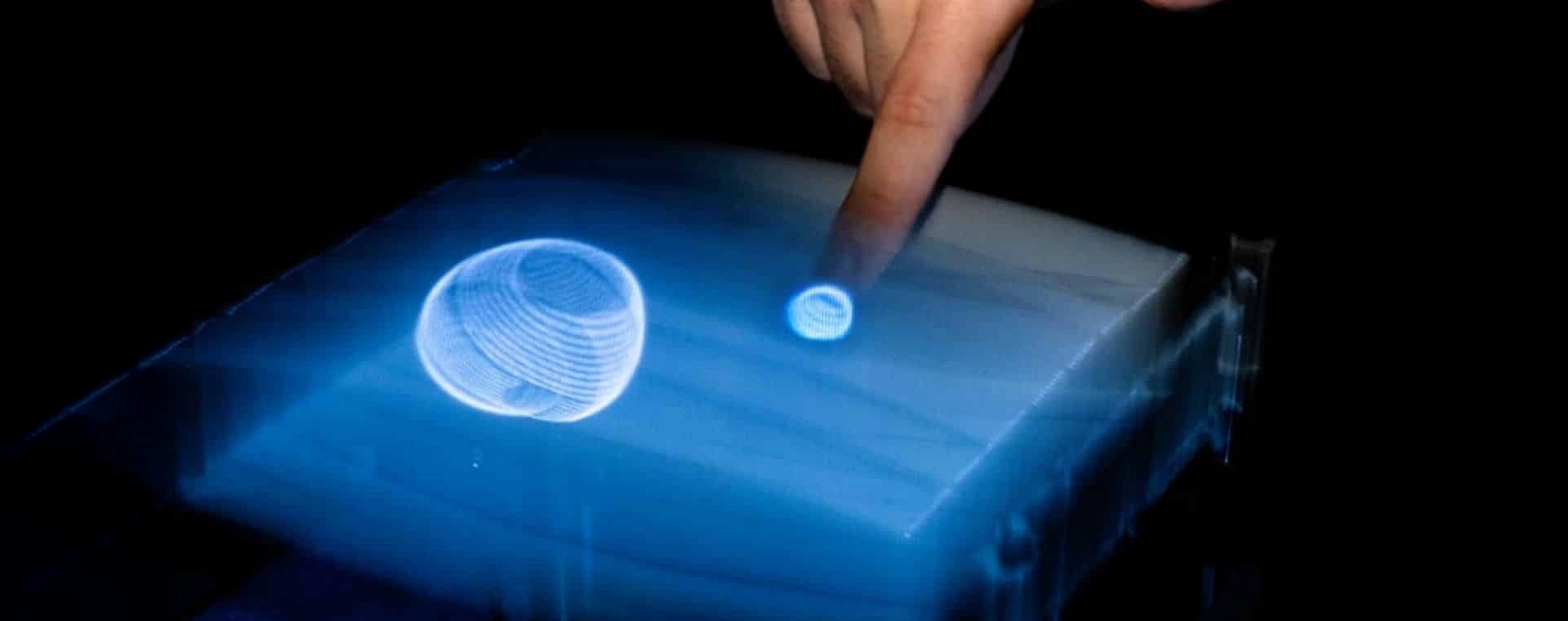
Touchable Holograms, Experience 3D Interactions in Mid-Air
What if I told you that you could reach out and touch a hologram? Not a screen, not a VR headset, but a real 3D object that appears out of nowhere and you can actually feel it with your hands.
It sounds like something from a sci-fi film, right? Well, it’s not. This is the magic happening thanks to volumetric display technology and touchable holograms. The future of interaction is already here, and it’s about to change everything from how we learn to how we shop. Curious to know how? Let’s dive in.
The Rise Of Touchable Holograms | The New Reality: Touchable Holograms
We’ve all seen holograms before, right? The first thing that comes into our minds is probably those flashy concert performances which include a holographic version of a dead artist performing live or the digital projections of futuristic technology that we have seen in movies like Iron Man. While these visuals are very cool, there has always been a huge disadvantage here, they are, but you cannot touch them. You can only look at them from afar, but in the physical world, you cannot interact.
Anyway, what if I told you it is all about to turn? Touchable holograms are the next stage. These holograms are now being developed in a way that you can actually reach and experience them in the physical world, not just limited to fiction. It is one thing called volumetric displays that produce 3D holographic objects floating in real space. Put these with mid-air interaction systems (for instance, ultrasound or air pressure feedback) and you receive a completely solid, touchable virtual object that can be interacted with your hand, fingers, or even your gestures.
Try to envision it for a moment. A virtual object is materialized from thin air, yet you are not simply allowed to see it; you can also physically manipulate it, twist, pull, or even get its texture like it is made of some natural fabric. It is not only a display, but also a bridge that connects the digital and physical worlds.
What Exactly Are Volumetric Displays?
Let us not be carried away too much by all the possibilities and first of all understand what exactly a volumetric display is. In simple terms, volumetric displays are three-dimensional (3D) images or holograms that occupy real space. Traditional 2D screens, which only show flat images, are quite different from volumetric displays. These visual data are so projected that one can see the depth and volume of the data.
Fabricating these holograms requires considerable lower voxels (the 3D version of pixels) to make the figure and the light which can be seen from all the angles, just like any other physical object in the world. With the emergence of a fantastic technological development, one can have a complete and deep experience as you are even able to physically walk around the figure, get a view through any angle you want, and also touch and make use of it as if it is right there in front of you.
What really raises the excitement even more would be the fact that these displays are also able to integrate different interaction methods-in the air. By employing such technology as ultrasonic waves or an air pressure system, users get the feeling that they are touching the hologram as if it were a solid object. The touch, which is felt, makes the brain register the hologram as something that can be physically touched, moved, and manipulated.
What is Volumetric Display | How Do Touchable Holograms Work?

Okay, so now you understand the concept, but the question is how does it work? A hologram that not only looks real but can be also felt, how is it possible? The answer lies in the mixture of two revolutionary technologies: volumetric display technology and haptic feedback systems.
Volumetric displays, for instance, are the starting point. Such displays build 3D objects by shining light into the air, generally through a system of small projectors or lasers. These projectors send out light which reflects on particles or reflective surfaces, thus, a 3D image is formed that can be seen from any direction.
Visual alone is not enough, of course, for the touchable feature; therefore haptic feedback systems are added. These systems employ methods such as concentrated ultrasound or air pulse to cause sensations on the skin which are identical to the feeling of the object being touched. When your hand goes through or touches the hologram, the force field of the haptic system is right there with you to create a physical sensation, a small but strong token reminding you that you are not just staring at a picture. You are contacting an actual thing, although it is hanging in mid-air.
It is a marvelous event. The sight and tactile reaction are functioning very well together and thus are creating an illusion that the virtual object is with you in your space. This level of interaction with digital objects is what the combination is allowing. The technology is not only for gaming or entertainment; in fact, it is destined to revolutionize healthcare, education, design, and other sectors.
Real-World Applications of Touchable Holograms
Now that you know how touchable holograms and volumetric display technology work, let’s talk about where this technology is being applied and how it’s already starting to make a difference.
1. Healthcare
Tactile holograms in medicine are the innovations that are changing the existing paradigm in medical training and surgical interventions. Surgeons now could execute simulations of challenging operations on 3D holographic display models of human organs as well as body segments without the use of cadavers or expensive physical models. So, these holograms are not only altering the structure, but you can also move, you can rotate, and you can even "cut" into it to mimic an actual operation. The touchable features of the displays give doctors the opportunity to acquire a more profound understanding of human anatomy and to make surgical training more secure and effective.
Imagine a medical student in Dubai learning about the human heart by interacting with a hologram that allows them to rotate it, zoom in on blood vessels, and feel the textures and contours of the tissue. Practically there are unlimited options, and the technology could be a turning point in the sector by letting superiors train more effectively, thus saving lives.
2. Design and Prototyping
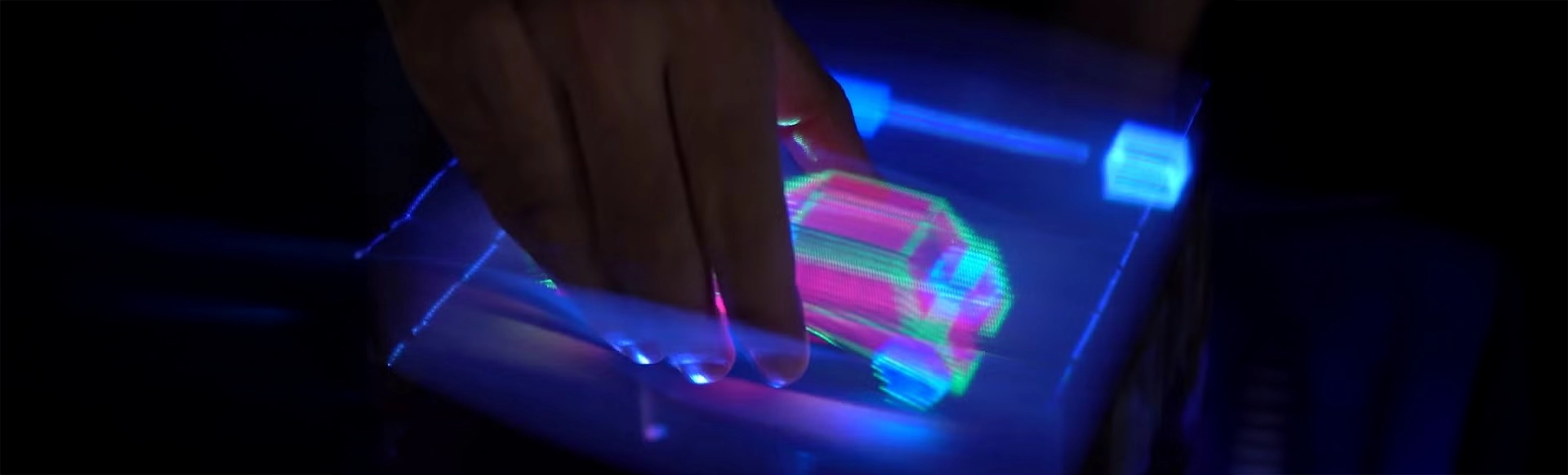
The availability of touchable holograms in designers and engineers technological palette signifies their departure to one uphill innovation that is product prototyping. No matter how the new vehicle is designed, you can still have the power to interact with a real 3D edition of the car model, instantly and physically by mimesis, without a need to come up with a physical prototype, and that is a giant step in the right direction. Any designer from the UAE or Saudi Arabia who is utilizing such technology to see the creation from all facets, zoom in to fish out the finest detail, and even “touch” the material properties of the object being created might as well been speeding up the procedure of design besides cutting down the cost of the traditional prototyping type.
3. Retail and Marketing
Hologram Manufacturers already started to integrate touchable holograms into the retail and marketing business, where they are mostly used in occurrence of luxury brands and immersive trading. How about if you can touch the car you always dreamt of before buying it or check every detail of a chair in your home with its hologram? In such a way, the shopping experience becomes more interactive and captivating, and customers are allowed to purchase when they feel confident. Companies in the UAE are already incorporating the technology of 3D holograms to present not only their products but also the industry sector in which they work in a more engaging and interactive way.
4. Entertainment and Education
This technology is likely to be most thrilling when its application is in entertainment or education. Try to picture it: history lessons in Saudi Arabia with present-day technology like kids researching holograms depicting ancient civilizations and actually feeling historical artifacts or interacting with landmarks they know. Besides these, museums and galleries are implementing this technology to give visitors more in-depth experiences who can now patiently visit, touch, and thoroughly glimpse digital reconstructions of artworks and sculptures.
5.The Middle East Leading the Charge
Volumetric display technology and touchable holograms in the UAE and Saudi Arabia are no longer seen only as a futuristic idea, but rather as the next reality. The UAE has basically been the first one to take up ground-breaking technology, let it be the smart-city projects of Dubai or Expo 2020, which had a variety of superposed image displays. On the other hand, Saudi Arabia’s Vision 2030 is all about creating a future where technology has a big part to play and the use of 3D holo-education, entertainment, and health sectors is the easiest step.
Both countries are in a position to be at the forefront of the market for touchable holograms and volumetric displays due to the rising demand for immersive experiences. The region’s pledge to technological innovation is that, ultimately, this technology will integrate seamlessly into daily life thereby changing people’s interaction with the environment around them.
Overcoming Hurdles: Touchable Holograms of the Future

In the bright future of touchable holograms, we still see some obstacles that the technology has to go through before it will be used at a large scale. One of the main issues is still the technology of the high-resolution, scalable volumetric display of which the cost is a major barrier. The difficulty in making these interactive and lifelike holograms results in these systems being very expensive to develop and produce. Nevertheless, like with other major innovations, the decrease in costs is anticipated. Their prices will decrease gradually, thus making it easy for more users to own such a technology as the number of market competitors and the technology's maturity go on.
Another problem with these displays is their energy consumption. It takes a lot of computing power to make volumetric holograms, which can be a limitation for the wide and everyday use of the technology. The energy used for making these holograms can be a factor that limits the size of the installations or the possibility of having them in normal households. Though, these displays will be made more efficient and will be better suited for both large-scale and personal use as an outcome of continuous advancements in computing power and energy efficiency.
These hurdles may exist, but they cannot be termed as absolutely impossible to overcome. The future is full of potential, and with the progress of technology, the touchable holograms that are more accessible, cheaper, and less energy-consuming will be found anywhere.
Final Thoughts
Touchable holograms? They're not just sci-fi things anymore. Volumetric display technology and mid-air interaction systems have made such fantastic wonders possible and we are seeing them one after the other. We are in a world where virtual objects aren’t just something we see they are the things we can feel. No, it’s not only the geeks who can benefit from such an advancement in technology; the healthcare, education, retail, and entertainment sectors are nodding their heads in unison confirming that this is a game-changer for them. The time has come for the industry of tech to be overshadowed by the era of touchable holograms flying in for a seamless digital transformation of the world.
This revolution is causing ripples in the UAE and Saudi Arabia, and the sky is the limit for such an innovation in the future. The time is near when we will not only use touchable holograms just as a means to interact with digital content but also as a way of forming bonds with the world around us. What is real and what is virtual? The difference is becoming less and less distinct and the manner in which we perceive them is about to become more thrilling, engaging, and authentic.