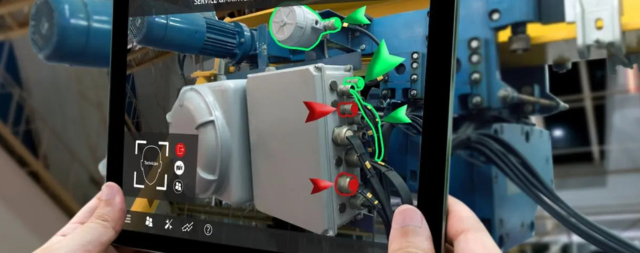
What Is Augmented Reality Used For? 15 Applications
Augmented reality is no longer a concept confined to science fiction or tech demos. In 2025, there are over 1.07 billion active mobile AR users worldwide and the global AR market is valued at $120 billion, on track to surpass $1 trillion by 2033. That is not a niche technology. That is a fundamental shift in how humans interact with the world around them.
So what is augmented reality actually used for? The honest answer is: far more than most people realise. AR is being deployed by surgeons navigating complex brain procedures, by retailers slashing product return rates, by sports franchises building fan loyalty inside stadiums, and by architects selling properties that have not yet been built. It spans every industry, every audience, and every scale from a child's first encounter with a heritage mural coming to life, to a factory engineer receiving live expert annotations on a turbine component.
This article breaks down 15 real-world augmented reality applications, each backed by a real case study, with video demonstrations so you can see the technology in action. Whether you are a brand, a government entity, or an enterprise exploring what AR can do for you, the use cases here will reframe what is possible.
1. AR in Tourism & Cultural Heritage
Augmented reality has given the tourism industry a remarkable gift: the ability to make the past visible again. Monuments, ruins, and murals that were static for centuries can now come alive in ways that connect visitors emotionally to history.
Case Study: Anim'Art — The Cardo Mural, Jerusalem
At the Cardo Maximus in Jerusalem's Old City, a 2D mural painted by French collective CitéCréation in the early 2000s depicts vibrant Byzantine marketplace life. A modern boy in a yellow shirt and red cap was deliberately woven into the scene — representing the continuity of the Jewish people across generations. Through the AR app developed by Anim'Art, visitors point their smartphones at the mural and watch that boy step out of the painting, move through the space, and interact with figures from antiquity.
This is AR tourism at its most powerful: not a gimmick, but a storytelling layer that transforms a passive wall into a participatory experience. For destinations across the UAE and wider GCC — where heritage sites such as Al Ain Oasis, Historic Jeddah, and the Diriyah heritage zone are undergoing large-scale tourism development — this kind of immersive interpretation unlocks entirely new visitor engagement models.
2. AR in Surgery & Medical Precision
In operating theatres, AR is saving lives by giving surgeons X-ray-like vision during complex procedures. The ability to overlay 3D anatomy derived from a patient's own MRI or CT scan directly onto the surgical field is eliminating guesswork from some of medicine's most demanding interventions.
Case Study: Medivis SurgeryAR
Developed by Medivis and run on Microsoft HoloLens 2 and Magic Leap 2, SurgeryAR is an FDA-cleared AR surgical platform deployed in hospitals including West Virginia University Medicine and Providence Swedish. A fiducial tracking array attached to the patient anchors the virtual anatomy to their physical body in real time. Surgeons can switch between planning mode (pre-operative 3D model), registration mode (aligning the digital scan to the actual head), trajectory visualisation (plotting the exact path for a drill or catheter), and live instrument tracking — all without looking away from the patient.
The AR and VR in healthcare market was valued at $4.04 billion in 2025 and is projected to reach $18.38 billion by 2034 (Precedence Research, 2025). Surgical navigation is at the leading edge of that growth. For a region like the UAE — where government investment in healthcare infrastructure is a Vision 2031 priority — AR-assisted surgery represents both a clinical advancement and a competitive differentiator for flagship hospitals.
3. AR in Medical Education & Anatomy Training
Beyond the operating room, AR is overhauling how future medical professionals learn the human body. Three-dimensional, spatially aware anatomy models enable students to explore complex biological systems in ways that are simply not possible with cadavers or flat-screen diagrams.
Case Study: ANOMY — Insight Heart on Apple Vision Pro
Insight Heart, developed by ANOMY, is the benchmark application for spatial medical education. On Apple Vision Pro, students use hand-tracking pinch gestures to rotate, scale, and "explode" a photorealistic 3D human heart. Anatomical labels — Aorta, Left Ventricle, Left Atrium — are anchored to precise locations on the model. The collaborative mode allows instructors to annotate the model in real time during group sessions, with notes persisting in shared spatial sessions for all participants.
Apple featured the app in multiple Vision Pro keynote presentations precisely because it illustrates what spatial computing enables that no prior medium could: studying beating cardiac muscle in three dimensions, from any angle, with your hands. The AR and VR training market is projected to grow at a CAGR of 24.5% through 2035 (Future Market Insights, 2025) — and medical education accounts for nearly 30% of that spend.
4. AR in Gaming & Mixed Reality Entertainment
The gaming industry has always been AR's most public-facing proving ground. What has changed in recent years is the depth of integration: modern mixed reality gaming does not just overlay graphics on your screen — it uses the geometry of your actual room as the level design.
Case Study: Habaduda Games — Toy Monsters on Meta Quest 3
Toy Monsters by Habaduda Games is a tower-defence game in the tradition of Plants vs. Zombies, rebuilt for the mixed reality era. On Meta Quest 3 and 3S, the game maps your physical room using Scene Mesh technology, then renders a "cracked wall" portal through which waves of monsters invade your living space. Players use bare hand-tracking — no controllers — to place defensive towers and battle the creatures. The tropical world visible through the portal coexists with your actual furniture, books, and walls.
This is not just a gaming achievement. It represents a new spatial computing paradigm where the "screen" disappears entirely and content inhabits shared physical space. For entertainment brands, retail activations, and experiential marketing campaigns, this same spatial layer opens possibilities that no flat-screen execution can match.
5. AR in Restaurants & Dining
The restaurant industry faces a persistent challenge: a menu description, however vivid, creates an imagination gap between expectation and reality. AR menus close that gap by letting customers see — at life size, on their actual table — exactly what they are about to order.
Case Study: Menu AR by Klik
Menu AR, developed by Klik, is available on both iOS and Android and supports WebAR, meaning customers can access 3D food models by scanning a QR code without downloading anything. The app generates photorealistic 3D scans of actual dishes accurately representing portion size, texture, and ingredient composition and anchors them to the table surface via markerless AR. Price, weight, and nutritional information hover alongside each model.
The result is measurable: restaurants using AR menus consistently report higher average check sizes and fewer ordering errors, as customers are genuinely confident in what they are choosing. For a region like the UAE where dining is a core hospitality and tourism pillar the potential for luxury hotels, restaurant groups, and food festivals to deploy this kind of technology is substantial and largely untapped.
6. AR in Industry 4.0 & Factory Operations
Manufacturing environments are complex, often dangerous, and packed with information that workers need to access without stopping what they are doing. AR overlays critical data assembly sequences, machine diagnostics, sustainability metrics directly onto equipment in the worker's field of view.
Case Study: Vaillant Group — AR Factory Tour
Global heating and cooling manufacturer Vaillant Group, working with Cologne agency Elastique., deployed an AR factory tour for partners, suppliers, and students visiting their Remscheid, Germany production facility. The experience, anchored to physical machinery, allows groups of up to 20 people to see the same AR content simultaneously — a technically demanding feat requiring group synchronisation. The Vaillant Rabbit mascot serves as a virtual guide, leading visitors through the brand's SEEDS sustainability strategy, with virtual trees and production milestone markers (representing energy savings and output milestones) overlaid on live equipment.
This is AR being used not just for operational efficiency, but as a brand storytelling and stakeholder engagement tool — a use case highly relevant for UAE industrial brands, free zone operators, and government entities seeking to showcase Vision 2031 infrastructure investments to visiting delegations.
7. AR in Art & Cultural Experience
Augmented reality is expanding access to art by breaking the physical constraints of galleries and museums. Entire rooms from history's greatest paintings can be reconstructed as walk-through spaces — and dropped into any location on earth.
Case Study: ARLOOPA — Van Gogh's Bedroom, Tbilisi
3D artist Ruslan Sokolovsky reconstructed Van Gogh's 1888 painting "The Bedroom in Arles" as a fully navigable 3D environment, deployable via the ARLOOPA app. The video, filmed on Rustaveli Avenue in Tbilisi against the backdrop of the National Gallery of Georgia, shows a portal anchored to the plaza's flat surface via markerless ARCore tracking. Users approach the door frame and walk through — stepping from the real street into Van Gogh's room, complete with his chairs, water basin, and the self-portrait he hung on his own wall.
For cultural institutions, art festivals, and public space activations — including Dubai's thriving arts calendar and Abu Dhabi's Louvre UAE programming — AR portals offer a genuinely new medium: exhibiting art that the physical gallery could never contain.
8. AR for Public Monuments & Commemorative Experiences
Some of the world's most celebrated public art installations were temporary — experienced by those who happened to be present, then gone forever. AR is creating a permanent access layer for these ephemeral works.
Case Study: Bloomberg Philanthropies — "The Gates" AR, Central Park
In February 2025, Bloomberg Philanthropies launched an AR experience on the Bloomberg Connects app to mark the 20th anniversary of Christo and Jeanne-Claude's iconic 2005 installation "The Gates." Users standing at 72nd Street in Central Park hold up their phones and see the saffron-coloured fabric gates precisely where they stood two decades ago — rendered in spatial AR anchored to actual park geography.
The experience demonstrates AR's potential as a medium for collective memory: restoring ephemeral moments of cultural significance to the places where they happened. For UAE's ambitious public art programmes, government commemorations, and EXPO legacy projects, this approach transforms any site into a permanent, interactive record of significant events.
9. AR in Live Sports & Fan Engagement
Sports is one of the most commercially competitive arenas in entertainment. Every broadcaster and venue operator is asking the same question: how do we deepen fan engagement beyond the game itself? AR is delivering answers that are simultaneously entertaining and commercially functional.
Case Study: ARound + LA Rams + Uber Eats — SoFi Stadium
During the 2024 NFL season, ARound (part of the Stagwell network) deployed "The Royal Tour" — a live AR broadcast segment at SoFi Stadium in Inglewood, California, sponsored by Uber Eats. The football field was transformed into a 3D stylised map of Los Angeles, featuring "HOLLYFOOD" instead of Hollywood, and animated caricatures of Rams stars Matthew Stafford, Cooper Kupp, and Aaron Donald racing across the field as food delivery characters. The segment aired on the stadium's 360° Infinity Screen and simultaneously within broadcast feeds.
It was AR functioning as a trifecta: entertainment, brand activation, and a functional tool (directing fans to use Uber Eats' in-stadium ordering). For sports rights holders, team sponsors, and venue operators in the UAE — where Formula 1, cricket, and football all attract massive audiences — this model illustrates how AR can turn a pitch or track into a commercial canvas.
10. AR & Generative AI — Virtual Companions
The intersection of AR and generative AI is creating a new category: spatial companions that live in your physical environment, respond to their surroundings, and can be customised by AI in real time. This is the next evolution of companionship technology.
Case Study: Niantic — "Hello, Dot" on Meta Quest 3
Niantic (the company behind Pokémon GO) released Hello, Dot for Meta Quest 3 in May 2024. A creature called Dot from the Peridot franchise inhabits your actual living room using the headset's depth sensors and passthrough cameras. It plays fetch with a virtual Dotball, responds to bare hand-tracking petting gestures, and reacts to the physical furniture and floor geometry of your actual home. Crucially, Dot's appearance can be redesigned on demand using a generative AI customiser: users describe a look ("starry coat," "purple spots") and the AI repaints the creature in real time.
This is AR not as productivity tool but as emotional medium a category with significant commercial potential for consumer brands, hospitality experiences, and theme-park attractions seeking to build mascot-led interactive encounters that guests can continue at home.
11. AR in Location-Based Entertainment
If single-room AR gaming is compelling, city-scale AR is transformative. Location-based mixed reality (LBMR) turns entire streets, plazas, and outdoor environments into interactive game levels a new category of entertainment that exists nowhere except at its designated coordinates.
Case Study: Future Circus — Dreampark, Santa Monica
Future Circus (co-founded by Brent Bushnell, whose father Nolan Bushnell founded Atari) launched Dreampark — an outdoor mixed reality theme park concept on Third Street Promenade in Santa Monica, California, in early 2025. The game, Super Adventure Land, charges players approximately $10 to wear Meta Quest 3 headsets. The real city street becomes the game level: virtual lava covers the pavement, players jump between floating digital platforms, punch invisible blocks for coins, and dodge monsters mapped to the physical environment. Real pedestrians pass through the scene, visible through the passthrough cameras.
This concept the "downloadable theme park" is one of the most commercially exciting emerging formats in location-based entertainment. For UAE tourism authorities, mall developers, and EXPO-era event planners, the model offers a scalable, low-infrastructure way to deploy entertainment experiences at any outdoor venue.
12. AR in Retail — Virtual Try-On
Virtual try-on (VTO) is one of augmented reality's most commercially proven applications. By letting customers see how a product looks on their body before purchasing, AR is solving one of e-commerce's oldest and most expensive problems: the return.
Case Study: Amazon — Virtual Try-On for Shoes
Amazon's Virtual Try-On for Shoes, launched in 2022 and since expanded globally, allows shoppers on iOS and Android to try on thousands of styles from Adidas, New Balance, Puma, Lacoste, and others before adding to cart. The app uses markerless AR computer vision to identify feet in real time, anchoring a 3D shoe model that tracks movement, walking, and angle — including top-down views. A dynamic carousel lets users switch colours without exiting the camera.
The business case is compelling: AR try-on users demonstrate conversion rates up to 90% higher than those who do not engage with the feature (BrandXR Research, 2025), and virtual try-on technology reduces return rates by 25–40% (Shopify, 2024). Sephora's parallel AR mirror trials led to an estimated 31% increase in sales. The global AR in retail market was valued at $4.2 billion in 2024 and is projected to reach $62.3 billion by 2033, growing at a CAGR of 41.7% (Custom Market Insights, 2024).
For brands selling fashion, beauty, eyewear, or footwear across the UAE and GCC — where luxury retail is a billion-dollar sector virtual try-on is not a future feature. It is a present commercial imperative.
13. AR for Remote Assistance & Expert Guidance
When a specialist cannot physically travel to a problem, AR can place their expertise — visually, precisely, in real time into the hands of whoever is on the ground. This is particularly transformative for global manufacturers, field service organisations, and critical infrastructure operators.
Case Study: Atheer — AiR Enterprise for Porsche
Atheer's AiR Enterprise platform is a remote AR collaboration system designed for deskless workers mechanics, field engineers, and technicians across industrial and automotive sectors. The platform streams a high-definition live feed from a technician's AR glasses to a remote expert at a desktop workstation. The expert can annotate the technician's field of view directly drawing arrows, placing text markers, circling specific components and those annotations appear in the technician's lenses in real time, hands-free.
Porsche deployed this technology through its "Tech Live Look" programme, allowing master technicians at central headquarters to guide local dealership mechanics through complex engine diagnostics without requiring in-person visits. The result: significantly faster resolution times and reduced travel costs across a global dealer network.
For UAE and GCC companies operating complex infrastructure — oil and gas facilities, airline maintenance, industrial plants this AR-enabled remote expert model reduces operational downtime without requiring scarce specialists to be physically relocated.
14. AR Navigation & Visual Wayfinding
GPS tells you where you are. AR navigation tells you which way to face and exactly where to go — solving the directional confusion that no blue dot on a map has ever fully resolved.
Case Study: Google — Maps Live View
Google Maps Live View solves the "blue dot problem": knowing where you are, but not knowing which direction you are facing. Unlike GPS which can be off by 30 metres in dense urban environments due to signal bounce off tall buildings Live View uses your camera to scan the surroundings and compares real-world facades against billions of Google Street View images using Global Localization technology. Large 3D arrows, street name labels, and distance markers are overlaid onto the live camera feed, pointing users through precise turns.
Available on both iOS (via ARKit) and Android (via ARCore), Live View represents one of the most widely used AR applications on the planet embedded in an app that over 1 billion people already use. For retail districts, exhibition centres, airports, and mega-developments like Dubai Creek Harbour or NEOM's THE LINE, AR wayfinding at this scale offers a blueprint for navigating complex spaces without printed maps or confusing signage.
15. AR in Architecture & Real Estate
Selling a property that does not yet exist requires imagination from both the seller and the buyer. AR eliminates that gap by placing photorealistic, full-scale buildings in their intended locations, allowing buyers to walk through rooms, adjust finishes, and visualise views before a single brick is laid.
Case Study: AR in Off-Plan Property Sales
Across global property markets, developers are deploying AR to sell off-plan projects with unprecedented buyer confidence. Prospective purchasers stand at a development site and, through an AR app, see the completed building rendered at full scale in its intended location. Internal viewing modes allow them to "walk" through units floor by floor, swap material finishes, and simulate the view from each window at different times of day.
The impact on sales performance is significant: real estate listings featuring AR content receive 403% more inquiries than those without (DataIntelo, 2024), and properties listed with AR content close 20–30% faster. AR technology also reduces property staging costs by up to 96%. The AR real estate tour market was valued at $2.1 billion in 2024 and is expected to reach $16.2 billion by 2033 at a CAGR of 23.8%.
For UAE developers operating in one of the world's most competitive off-plan property markets where buyers from 90+ nationalities make decisions remotely AR visualisation is a conversion tool with demonstrable ROI.
The Common Thread: AR Bridges the Gap Between Imagination and Reality
Across all 15 applications above, a single principle connects them. Every one of these deployments exists because there was a gap between what a person could imagine and what they could see, between where an expert was and where the problem was, between what a product promised and what it delivered.
Augmented reality is the bridge.
"The opportunity for augmented reality is not in replacing the physical world it is in enriching it. Every surface, every space, every object becomes a potential interface." Tim Cook, CEO, Apple (Apple Worldwide Developers Conference, 2023)
The industries represented here tourism, healthcare, retail, manufacturing, sports, entertainment, architecture, navigation account for trillions of dollars of economic activity in the UAE and GCC alone. As AR hardware moves from specialist headsets to everyday smart glasses (a segment that grew 44.4% in 2025 according to IDC), the barrier to deployment is dropping fast.
The question for brand and enterprise decision-makers is no longer "what is augmented reality used for?" It is "which of these applications is our organisation not yet leveraging and what is that delay costing us?"
If you are ready to explore what AR can deliver for your brand, event, or space, Ortmor Agency's team of creative technologists has been building immersive AR experiences for government and enterprise clients across the UAE and GCC for years. Explore our AR capabilities here.
For broader immersive technology context — including how AR, VR, and projection mapping work together — visit our experiential marketing services page or explore Ortmor ArtLab, where our research and innovation work lives.
Frequently Asked Questions
Q: What industries use augmented reality the most?
A: The industries with the highest current AR adoption are retail and e-commerce (virtual try-on), healthcare (surgical navigation and medical training), manufacturing and industrial operations (remote assistance, digital twins, and factory tours), gaming and entertainment, and architecture and real estate. Sports, tourism, and public art are growing rapidly as well. Across all sectors, the common driver is the ability to close a gap between physical reality and the information, experience, or product a user needs to see.
Q: Is augmented reality different from virtual reality?
A: Yes. Virtual reality (VR) replaces your real-world surroundings entirely with a digital environment — you cannot see the physical world around you. Augmented reality (AR) overlays digital content onto your actual surroundings, which remain visible. Mixed reality (MR) is a more advanced form of AR where digital objects are aware of and can interact with the physical environment, anchored to surfaces and occluded by real-world objects. In practice, many modern experiences blend AR and MR capabilities. You can explore the full distinction in our AR vs VR guide on the Ortmor blog.
Q: Can small businesses use augmented reality, or is it only for large brands?
A: AR is increasingly accessible for businesses of all sizes. WebAR — augmented reality that runs in a browser via QR code scan, without requiring a downloaded app — has dramatically lowered the cost and technical barrier to entry. A restaurant can deploy an AR menu for a fraction of what it would have cost five years ago. An architect or interior designer can provide AR property tours using off-the-shelf tools. For more complex, custom experiences — branded activations, event installations, industrial AR — specialist agencies like Ortmor design and build bespoke solutions. The technology scales with budget and ambition.
Q: How accurate is AR tracking technology in 2025?
A: Modern markerless AR tracking — used in applications like Google Maps Live View, Amazon's Virtual Try-On, and most consumer AR experiences — is highly accurate and stable under normal conditions. Indoor positional AR has improved significantly with the introduction of LiDAR sensors (available in iPhone Pro models since 2020 and Meta Quest since 2021), which create detailed 3D maps of interior spaces in real time. Surgical and industrial AR applications that require centimetre-level precision typically use fiducial markers or infrastructure-integrated tracking systems to achieve the accuracy required for safety-critical use. For most commercial and experiential applications, today's tracking is more than sufficient to deliver compelling, reliable experiences.
Q: What does augmented reality mean for event and brand experiences in the UAE?
A: The UAE is one of the world's leading environments for large-scale brand and government events — from Global Village and GITEX to state summits and national day celebrations. AR opens several powerful layers for these contexts: interactive product demonstrations at exhibitions, AR-enhanced stage performances and broadcasts, wayfinding and visitor engagement in large venues, virtual try-on and brand activations in retail environments, and commemorative AR experiences tied to government milestones. Ortmor Agency has delivered immersive technology experiences for government and enterprise clients across these formats. See our case studies or get in touch to discuss your brief.
Sources & References
-
Global Augmented Reality Market Size — Grand View Research (2025)
-
Mobile AR Users Worldwide 2025 — Statista (2025)
-
AR & VR in Healthcare Market — Precedence Research (2025)
-
AR & VR in Training Market 2025–2035 — Future Market Insights (2025)
-
AR in Retail Market Size — Custom Market Insights (2024)
-
AR Virtual Try-On Conversion Rates — BrandXR Research Report (2025)
-
Virtual Try-On Return Rate Reduction — Shopify (2024)
-
Sephora AR Sales Uplift — Braze / Sephora Case Study (2024)
-
AR Real Estate Tour Market — DataIntelo (2024)
-
XR Market 44.4% Growth 2025 — IDC (2025)
-
Medivis SurgeryAR — Medivis Official
-
Atheer AiR Enterprise — Atheer Inc.
-
Bloomberg Connects — "The Gates" AR — Bloomberg Philanthropies (2025)
-
Niantic Hello, Dot — Meta Quest 3 — Niantic Spatial Inc. (2024)
-
Vaillant AR Factory Tour — Elastique Agency
-
Menu AR by Klik — Klik OOO
-
ARLOOPA — Van Gogh Bedroom Portal — ARLOOPA Inc
-
ARound — SoFi Stadium, LA Rams — ARound / Stagwell (2024)
-
Future Circus — Dreampark, Santa Monica — Future Circus (2025)
-
Amazon Virtual Try-On for Shoes — Amazon Fashion