Holographic AI Companionship: The Future of Human Interaction
There was a time when talking to a computer felt mechanical. You typed, it responded, and that's the end of the story.
Today, we talk to voice assistants while driving. We rely on chatbots for support. Some people even build daily routines around digital tools that feel surprisingly personal. But we’re still interacting through screens and speakers.
Now imagine this instead:
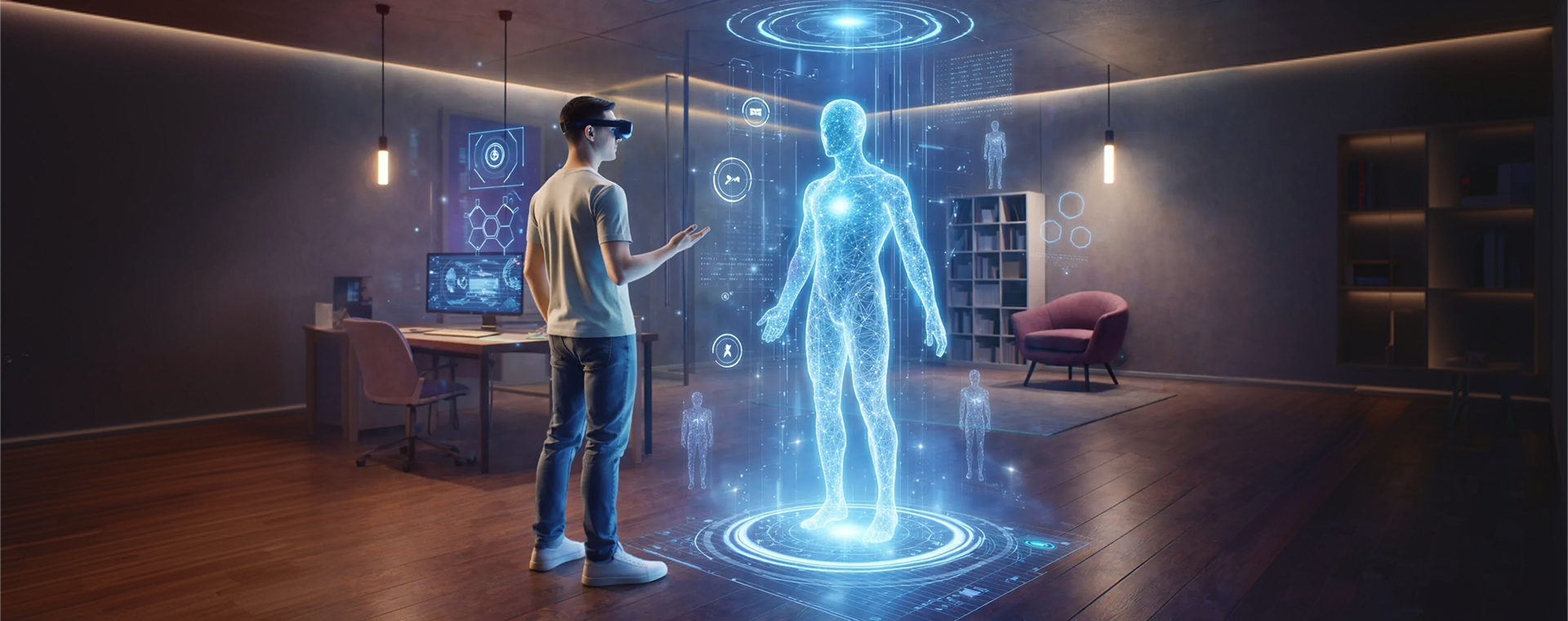
An intelligent presence standing in your space. It looks at you. It responds in real time. It remembers what you said yesterday. It adapts to your tone. It feels… present.
That’s where holographic AI companionship begins.
And it’s moving faster than most industries realize.
What Is Holographic AI Companionship?
Essentially, holographic AI companionship integrates sophisticated AI companions with spatial, visual projection systems.
These are much more than simple chatbots and voice assistants; they are basically embodied digital entities that can be seen with the help of holographic technology or mixed reality systems.
This isn’t science fiction. It’s the convergence of three real technologies:
-
Generative AI and emotional AI systems
-
Immersive hologram experiences powered by projection, transparent displays, or AR headsets
When these layers work together, the result is a virtual companion that doesn’t just respond; it interacts.
And that shift from response to interaction changes everything.
Why Presence Matters in Human-AI Interaction
Humans are wired for presence.
We respond to eye contact, we read body language, and we feel comfort in spatial awareness, even subtle cues like proximity and posture.
Traditional AI lives behind glass screens.
But once AI enters space as a visible, animated form, human-AI interaction becomes more intuitive. More natural. More engaging.
It’s no longer “using software.”
It becomes related to something.
That psychological shift is what makes holographic AI companionship powerful.
Where This Technology Is Already Taking Shape
Let’s bring this down to earth.
1. Experience Centers and Exhibitions
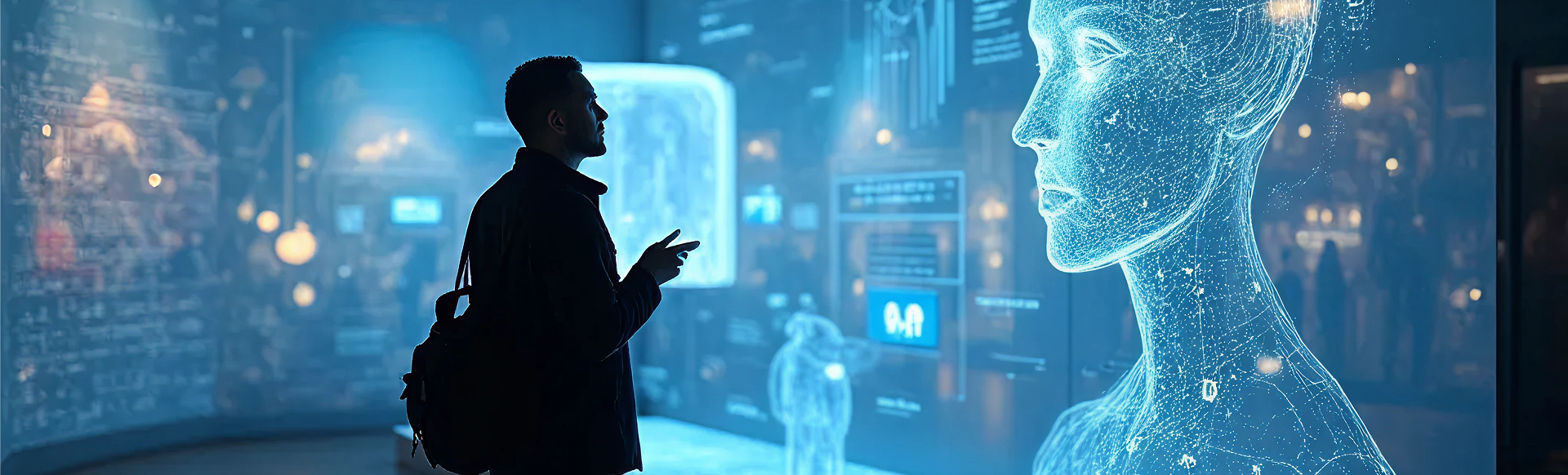
If you were to step inside a technology pavilion, what would it be like to be greeted not by static screens explaining an innovation, but by a holographic AI ambassador that asks you what you're interested in and then adjusts its explanation based on your responses, even guiding you through the space?
It no longer is a passive display.
The exhibition becomes an adaptive storytelling experience.
Holographic AIs can become dynamic guides, creating an engaging mix of information, personalization, and spectacle by helping brands and governments, who through immersive environments are investing in such innovative experiences, to do just that.
2. Smart Homes and Personal Environments
In domestic spaces, AI companions could evolve beyond voice reminders.
Picture a virtual companion projected in your workspace that:
-
Helps structure your day
-
Offers wellness prompts
-
Tracks habits
-
Provides contextual support
Because it remembers patterns, it becomes more tailored over time.
3. Healthcare and Emotional Support
In elderly care, loneliness is a growing challenge.
Virtual companions powered by emotional AI can:
-
Engage in conversation
-
Detect mood shifts through voice tone
-
Provide routine reminders
-
Encourage social connection
While they don’t replace human relationships, they can supplement support systems in meaningful ways.
The key lies in thoughtful design, making sure technology supports human connection, not substitutes it.
The Role of Emotional AI
A big reason holographic AI companionship feels compelling is emotional responsiveness.
Modern AI systems are beginning to recognize tone, pacing, and conversational patterns. When paired with expressive digital avatars, they can simulate empathy, pausing when you pause, softening tone when needed, and adjusting language based on context.
This doesn’t mean AI “feels.”
But it can model behavior in ways that feel emotionally intelligent.
And in immersive hologram experiences, that emotional nuance matters more than visual realism.
In fact, the most impactful interactions won’t necessarily depend on ultra-high-definition visuals. They’ll depend on believable behavior.

The Technology Behind the Illusion
Let’s demystify something.
Most “holograms” today are not free-floating beams of light. They’re created using techniques such as:
-
Transparent OLED displays
-
Pepper’s Ghost projection setups
-
LED holographic fan displays
-
Augmented reality headsets
What makes them convincing isn’t just projection quality; it’s integration.
Low latency, real-time processing, natural voice synthesis, and memory continuity.
When those systems align, the experience feels cohesive.
And cohesion builds trust.
Business Implications: Why It Matters Now
For the most innovative enterprises, holographic AI companionship goes beyond being just a cool tech feature.
It serves as a strategic interface.
For instance, it can highly customize customers experiences in retail settings.
It can communicate the brand's essence in corporate lobbies.
In schooling scenarios, it can tailor explanations to the capability of individual learners.
The key benefit is that of personalization at scale.
AI partners, unlike human personnel or static content, can change in real, time the language, granularity, mood, and even the character type.
This, therefore, becomes a great differentiator for companies working on creating immersive settings or smart buildings.
Ethical Considerations We Can’t Ignore
As exciting as this technology is, it carries responsibility.
Questions naturally arise:
-
How is user data stored and protected?
-
Could emotional attachment become unhealthy?
-
Should AI companions clearly disclose their artificial nature?
-
Where is the boundary between assistance and dependency?
These are not abstract concerns.
The more immersive human-AI interaction becomes, the more important transparency and ethical design will be.
Organizations that approach this space with integrity will build long-term trust. Those who chase spectacle without safeguards may face backlash.
What the Future Looks Like
We’re moving toward environments where digital systems don’t just respond to commands.
They collaborate.
Holographic AI companionship represents the next layer of interface evolution from screens to spatial presence.
In the near future, we may see:
-
Virtual companions representing historical figures in museums
-
AI-powered sustainability ambassadors in smart city exhibitions
-
Personalized learning assistants appearing on demand
-
Corporate AI guides welcoming visitors in innovation hubs
Final Thoughts
Technology has constantly changed the way people communicate.
First text, then voice, then video.
Now the presence.
Holographic AI companions will not replace human connection. Rather, they will improve our interaction with digital systems in more natural, spatial ways.
When done with care, AI companions can make technology seem less remote, more interactive, more reliant on context, and more focused on humans.
And for industries investing in immersive environments, this isn’t a distant future concept. It’s the next design frontier.
The real question isn’t whether virtual companions will become part of our spaces.
It’s how intentionally we choose to build them.